 Read More

 Get A Quote

How to Choose a Liquid Flow Transmitter: Electromagnetic Types, Accuracy, Installation
Home / News / Industry News / How to Choose a Liquid Flow Transmitter: Electromagnetic Types, Accuracy, Installation
Product Category
NEW Category
Contact us
Contact Us
We specialise in the research, development and manufacture of electrical wires and cables.
 +86 13967196545
Related News
How to Choose a Liquid Flow Transmitter: Electromagnetic Types, Accuracy, Installation
Content
- 1 What Is a Liquid Flow Transmitter?
- 2 Why Electromagnetic Liquid Flow Transmitters Are a Strong Baseline
- 3 Choosing a Liquid Flow Transmitter: Key Criteria to Evaluate
- 4 Calibration and Factory Quality Assurance
- 5 Where Liquid Flow Transmitters Are Used Every Day
- 6 Frequently Asked Questions
- 6.0.1 Q1: What is the minimum conductivity for a liquid flow transmitter?
- 6.0.2 Q2: Can a liquid flow transmitter measure non-conductive liquids like oil or fuels?
- 6.0.3 Q3: Why does a magnetic flow transmitter show a reading when there is no flow in the pipe?
- 6.0.4 Q4: What is the practical difference between an integrated and a remote transmitter?
When a flow transmitter on a caustic transfer line starts to drift, the dosing ratio falls out of tolerance, and an entire batch ends up off-spec. Problems like these rarely come from the meter itself; they usually come from a mismatch between the transmitter and the field conditions. Choosing a liquid flow transmitter is first a matching exercise, not a specification exercise. For most conductive liquid applications, the electromagnetic design is the strongest baseline, and this guide explains what that means in practice.
What Is a Liquid Flow Transmitter?
A liquid flow transmitter is an instrument that measures the flow rate of a liquid inside a closed pipe and converts it into a standard industrial signal, usually a 4-20 mA loop, a pulse output, or a digital communication protocol. It is the transmitter version of a flowmeter: the sensor produces a raw velocity or differential signal, and the electronic head converts that into a field-readable value.
Flow measurement as a discipline covers many principles, from mechanical turbine meters and oval gear meters to pressure-based orifice plates and thermal mass designs. Each method has a place in industry. For liquids, however, the practical issues are different from gases. Liquids are largely incompressible, and many industrial liquids are conductive. Conductivity is what makes the electromagnetic approach interesting: it can measure the flow of water, wastewater, chemical solutions, slurries, and juices without any moving part touching the stream.
Why Electromagnetic Liquid Flow Transmitters Are a Strong Baseline
Electromagnetic flow transmitters rely on Faraday's law of induction. A magnetic field is generated across the measuring tube, and the movement of a conductive liquid induces a voltage that is proportional to the flow velocity. The electrodes sense the voltage, and the transmitter computes the volumetric flow rate.
The absence of moving parts gives electromagnetic transmitters a practical advantage in liquids that contain solids, such as raw sewage, paper pulp, or slurries. Mechanical meters suffer from wear and blockage risks in those streams. An electromagnetic flow meter also produces no additional pressure loss, which means the pump setpoint stays stable. It is this combination of reliability and low maintenance that makes the electromagnetic principle the default choice in water, chemical, and slurry applications.
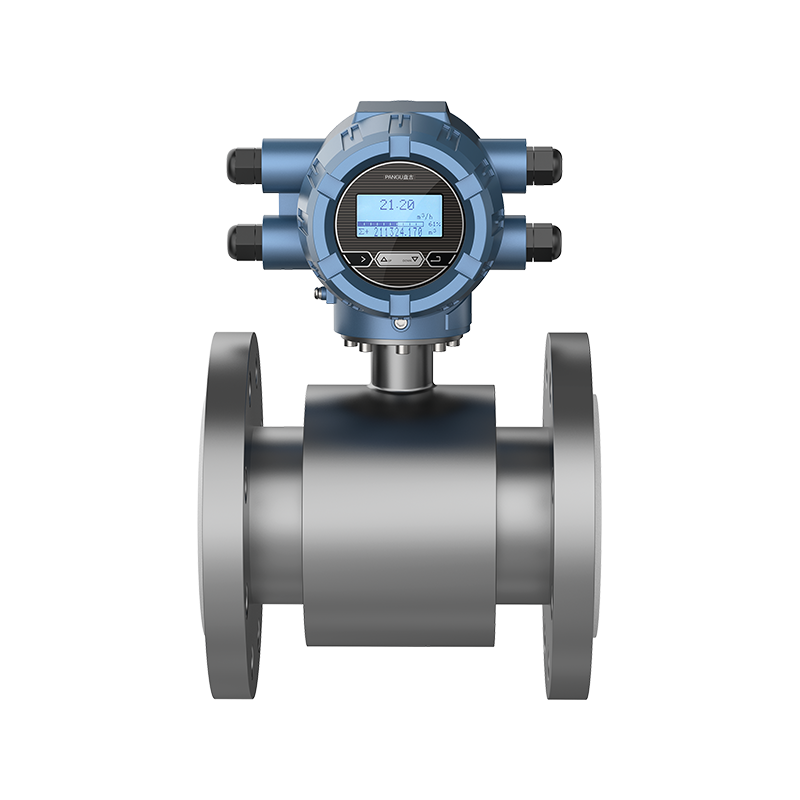
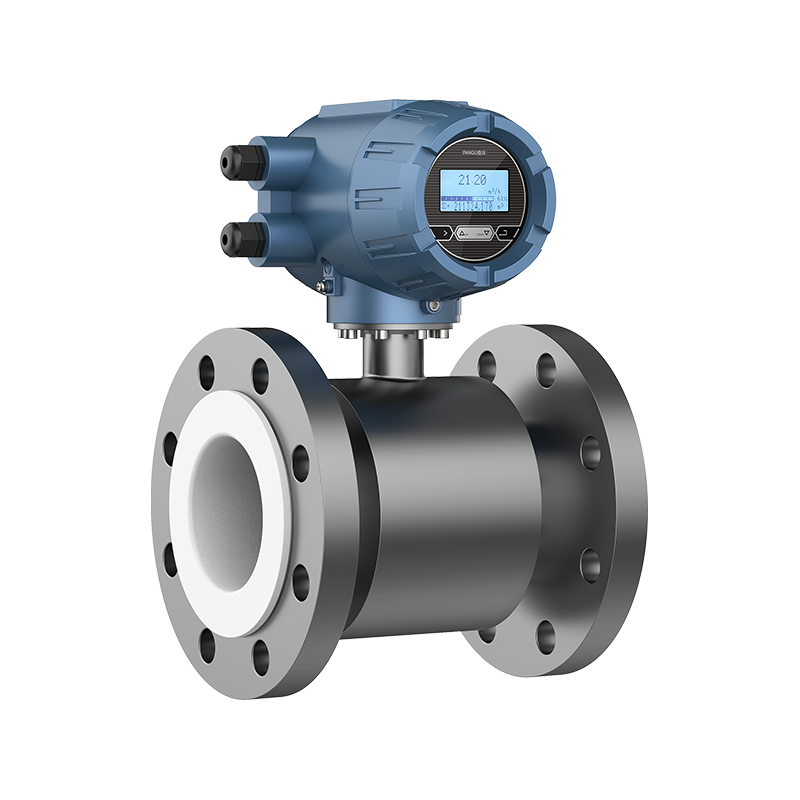
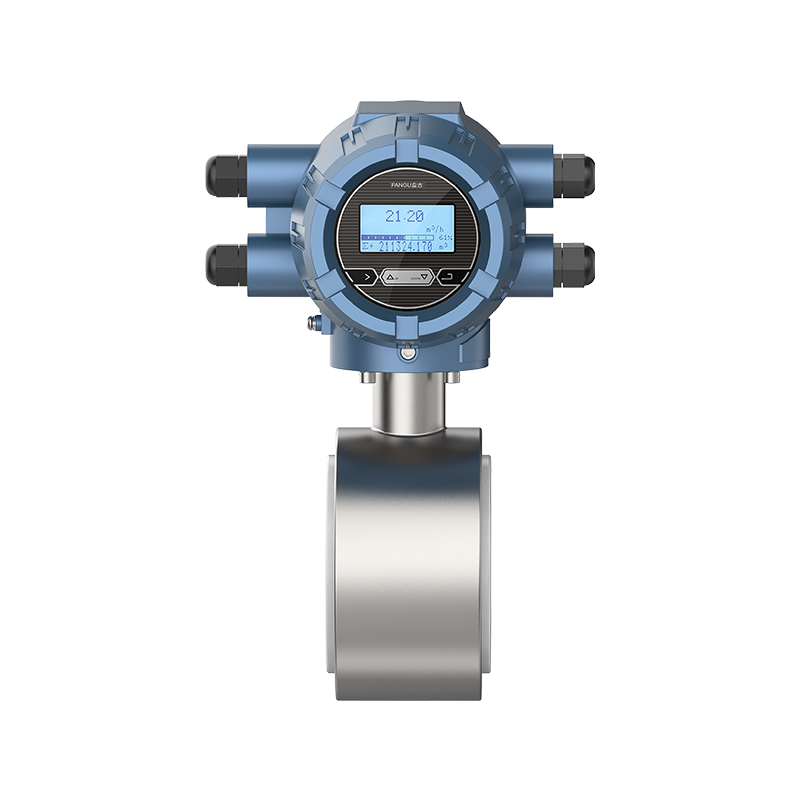
For installations where the space is limited or the control panel is close to the pipeline, an integrated electromagnetic flow meter combines the sensor and the transmitter into a single housing. It is a convenient option for new and retrofit projects, and it reduces wiring complexity compared with a split design.
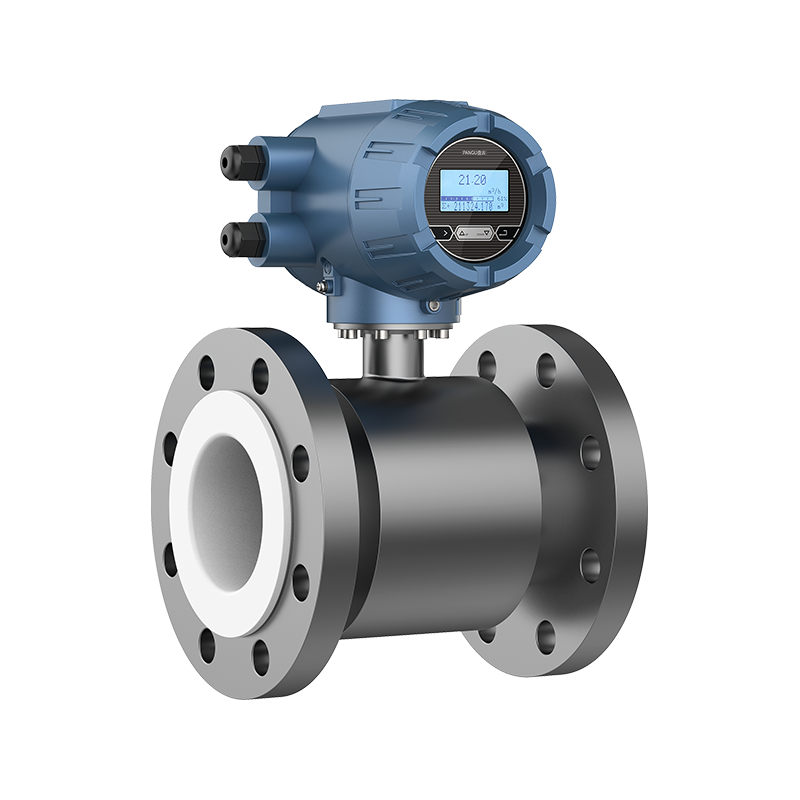 Integrated Electromagnetic Flow Meter for Space-Limited InstallationsThis all-in-one meter combines sensor and transmitter, reducing wiring complexity and installation footprint. Ideal for retrofit projects where pipeline space is tight or control panels are nearby.View Product →
Choosing a Liquid Flow Transmitter: Key Criteria to Evaluate
Selection checklist
- Is the liquid conductive? Most electromagnetic transmitters have a minimum conductivity threshold, typically around 5 microsiemens per centimeter. Specialized low-conductivity versions can measure down to a lower level, but that is a technical discussion with the supplier, not a standard catalog promise.
- What is the expected velocity range in the pipe? For a given pipe size, a velocity between 0.5 and 5 m/s gives the most stable measurement. If the velocity is too low, the signal becomes weak. If it is too high, the risk of erosion and cavitation increases.
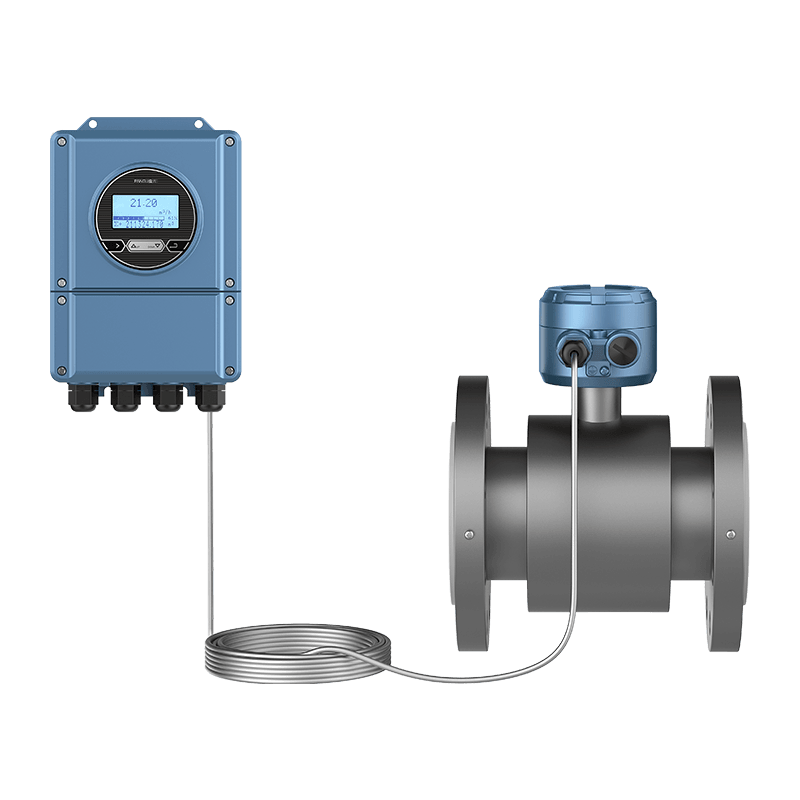
- Which installation style fits the site? An integrated unit is a good fit when the pipeline is indoors and the ambient temperature is moderate. A split-style remote transmitter keeps the electronics away from heat, vibration, or physical access issues, which is valuable on buried pipes or in high-temperature process lines. A clamp-on instrument is typically chosen for existing pipelines where cutting into the pipe is not desirable.
| Installation style | Best for | Typical constraint |
|---|---|---|
| Integrated | Clean water; indoor process lines | Electronics exposed to ambient temperature |
| Split / remote | High-temperature or buried pipes | Longer signal cables and extra mounting work |
| Clamp-on | Existing pipelines without cutting | Requires known outer diameter and wall thickness |
When the flow value is used for commercial settlement or custody transfer, accuracy becomes the dominant decision factor. A high-precision electromagnetic flow meter with an accuracy of plus or minus 0.2% of flow rate is not just a marketing claim; it reflects a measurable reduction in financial uncertainty over thousands of tons delivered per year.
 High-Precision Electromagnetic Flow Meter for Custody TransferWith ±0.2% accuracy, this meter minimizes financial uncertainty in commercial settlement. Suitable for dosing and irrigation systems requiring precise flow measurement.View Product →
Calibration and Factory Quality Assurance
A liquid flow transmitter is only as good as the calibration behind it. In practice, calibration is the invisible spec that determines whether a measured flow rate is usable for process control or financial accounting. Every measurement device carries uncertainty, and the size of that uncertainty is set during calibration.
The most reliable way to reduce the uncertainty budget is to verify the transmitter against a high-precision flow rig. For example, the calibration facility at Pangu Automation covers DN15 through DN1000 pipe sizes and uses three independent flow lines. The facility applies both the master meter method and the static gravimetric method. In the master meter method, the device is compared to a reference flowmeter that has a known uncertainty. In the static gravimetric method, water is collected over a measured time interval and weighed, then converted to volume using the density at the test temperature. Running two independent methods gives a useful cross-check and helps identify systematic errors that a single method might miss.
DN15 to DN1000 coverage
3 independent calibration lines
2 calibration methods
Calibration is not a routine that ends when the device leaves the factory. It is the reason a flow transmitter can be trusted in the field. When your maintenance team changes a transmitter, the calibration record is what gives them confidence that the reading will match the process conditions.
Where Liquid Flow Transmitters Are Used Every Day
Liquid flow transmitters operate across municipal, industrial, and building energy systems. The most common deployment is in chemical plants, where corrosive or reactive liquids require careful material selection. In a chemical industry flow meter application, the liner and electrode materials are chosen case by case, because the range of process fluids is wide.
Water utilities use flow transmitters for balancing distribution networks, controlling pump stations, and tracking consumption. In a water supply flow meter setup, the transmitter is often paired with a data logger or a flow computer to support tariffs, reporting, and leak detection.
The same principle extends to wastewater and sludge handling. However, when the fluid contains abrasive solids, standard coated sensors may need a more robust design. A slurry-type electromagnetic flow meter with a reinforced liner and an enlarged electrode area is often a safer choice. In these environments, the solid particles create erosion, but the absence of moving parts already eliminates the typical failure modes of a mechanical meter.
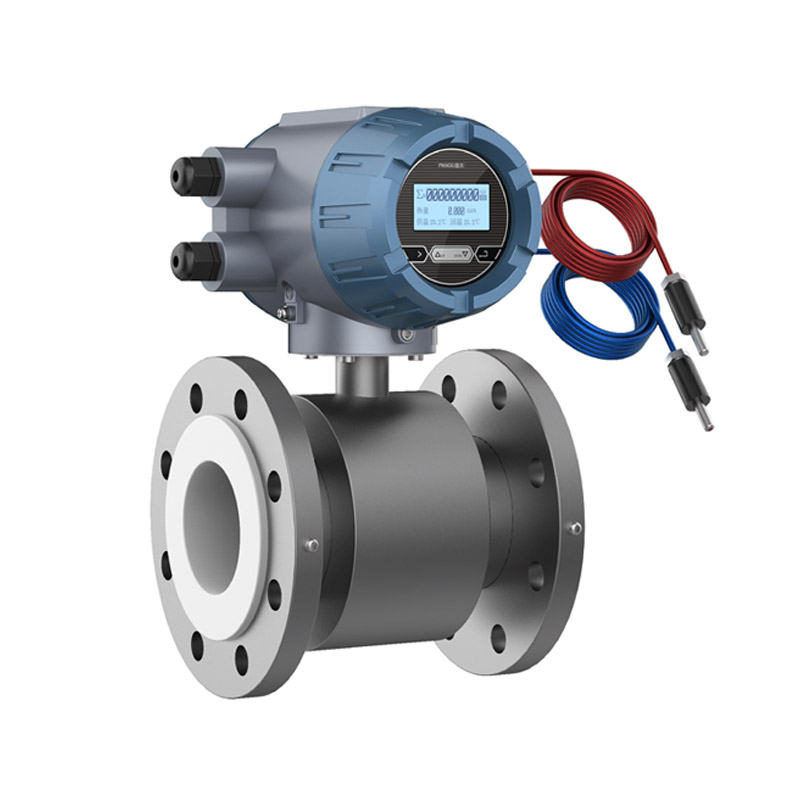
 Slurry Electromagnetic Flow Meter with Enhanced Signal ProcessingDesigned for abrasive slurries, this meter features increased excitation frequency and filtering algorithms to stabilize flow signals despite solids, ensuring reliable measurement in wastewater handling.View Product →
HVAC and building energy systems also rely on flow measurement for cooling and heating loads. In those projects, the flow signal goes directly into a heat computer or a thermal energy meter. This is a reminder that every flow transmitter application is ultimately a background process; the most important result is the robustness of the full measurement loop.
Frequently Asked Questions
Q1: What is the minimum conductivity for a liquid flow transmitter?
Most electromagnetic flow transmitters require a liquid conductivity of at least 5 microsiemens per centimeter. If your process fluid is below this level, you need to discuss the application with the supplier before specifying a product.
Q2: Can a liquid flow transmitter measure non-conductive liquids like oil or fuels?
Standard electromagnetic designs cannot measure non-conductive liquids, because the induced voltage depends on charge movement. For oils and hydrocarbons, you need other technologies, such as Coriolis or positive displacement meters.
Q3: Why does a magnetic flow transmitter show a reading when there is no flow in the pipe?
This is a common commissioning error. The sensor may be exposed to air, the pipe may be partially filled, the signal cable may not be properly shielded, or there may be stray electrical interference. Always check that the pipe is completely full and that the cable is a dedicated twisted pair.
Q4: What is the practical difference between an integrated and a remote transmitter?
The integrated case is compact and simple, but the electronics will experience the full ambient temperature range. A remote transmitter keeps the electronic head in a safer environment, which can extend the service life in hot or humid conditions.
PREV:Commercial Water Meter Guide: How to Choose the Right Electromagnetic Meter
NEXT:Potable Water Flow Meter: Accurate Measurement for Utilities & Industry
NEXT:Potable Water Flow Meter: Accurate Measurement for Utilities & Industry
Interested in cooperation or have questions?
Contact Us Now!
Kelly

+86 13967196545

pangusales@vip.163.com
Production Base:

Building 1 and Building 42, No. 889 Huancheng North Road, Deqing County, Huzhou City, Zhejiang Province
Jiji
+86 15397010616
pgsalesjiji@vip.163.com

+86-0571-87770830
Corporate Headquarters:
602-702, Block D, Building 3, Area B,Xigang New Territories, 206 Zhenhua Road,Hangzhou City, Zhejiang Province, China

Copyright © Hangzhou Pangu Automation System Co., Ltd. Rights Reserved.
Custom Digital Panel Mount Industrial Instruments Suppliers
