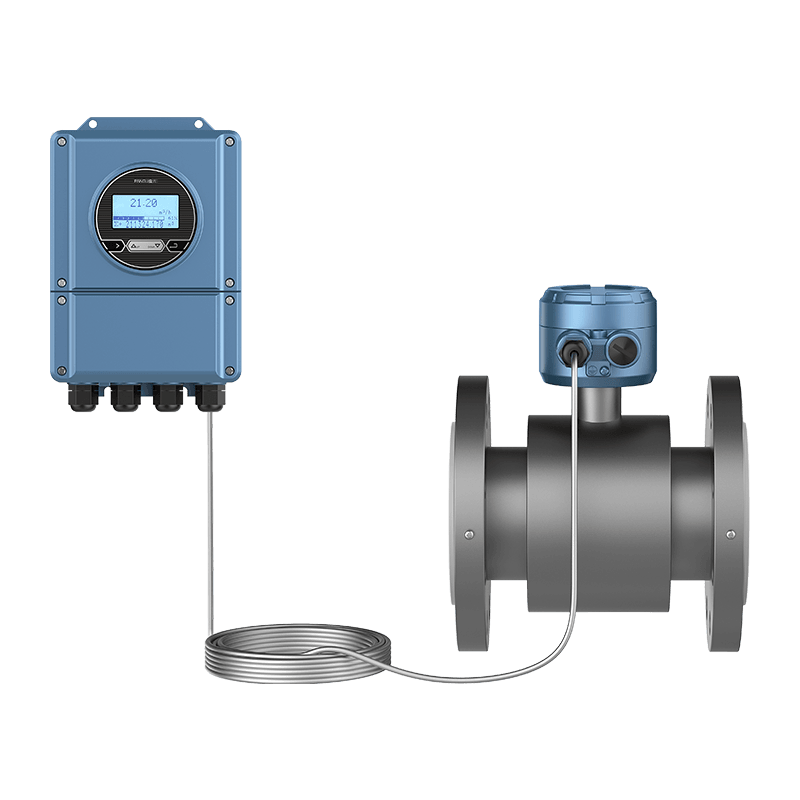
 Read More

 Get A Quote

Electromagnetic vs Mechanical Flow Meters: How to Choose the Right One
Home / News / Industry News / Electromagnetic vs Mechanical Flow Meters: How to Choose the Right One
Product Category
NEW Category
Contact us
Contact Us
We specialise in the research, development and manufacture of electrical wires and cables.
 +86 13967196545
Related News
- How Do You Choose the Right Magnetic Flow Meter for Your Process Fluid?
- Commercial Water Meter Guide: How to Choose the Right Electromagnetic Meter
- How to Choose a Liquid Flow Transmitter: Electromagnetic Types, Accuracy, Installation
- How to Choose a Flow Meter That Survives Aggressive Chemical Service
Electromagnetic vs Mechanical Flow Meters: How to Choose the Right One
Content
A mechanical turbine meter on a cooling water header rarely fails loudly. The rotor erodes, the bearing wears, and a reading that drifts 2 to 4 percent low over 12 to 18 months is easy to miss until the plant energy balance stops closing. Put an electromagnetic meter on the same pipe and there is no rotor left to wear, but the meter will read nothing at all if the liquid stops conducting electricity.
That trade-off drives most of the selection work between the two families. The rest comes down to conductivity, turndown, pressure loss, and how much maintenance your team can realistically absorb over a ten-year service life.
Quick answer
Choose electromagnetic when the liquid conducts electricity and you want accuracy, near-zero pressure loss, and almost no wear parts on water, wastewater, or slurries. Choose mechanical when the fluid is non-conductive, when there is no power at the pipe, when the medium is gas or steam, or when you need dependable accuracy at very low flow in a small line.
How Each Meter Turns Flow into a Number
Electromagnetic meters: voltage, not rotation
An electromagnetic meter works on Faraday's law. A conductive liquid moving through a magnetic field generates a voltage, and two electrodes set flush with the pipe wall pick up a signal proportional to the average velocity. The bore stays completely open, so permanent pressure loss is essentially the same as an equal length of straight pipe, and there is no rotor, gear, or chamber to wear.
The catch is conductivity. Standard sensors need roughly 5 µS/cm or more, which covers potable water, wastewater, most acids and caustics, and mineral slurries. Deionized water, hydrocarbons, vegetable oils, and many solvents fall below that line, and low-conductivity designs only stretch the limit so far. Check the actual fluid data at the lowest expected process temperature before you commit.
Mechanical meters: the fluid has to push something
Mechanical meters take the opposite approach. A turbine rotor spins at a speed proportional to velocity; a positive displacement meter traps fixed volumes and counts them; a paddle wheel simply turns in the stream. Turbine and positive displacement designs typically start at ±0.5 to ±1 percent of reading, and both will run on non-conductive liquids without complaint. The cost is wear: bearings, blades, and clearances that change dimension over time, plus a permanent pressure drop across the meter body.
Electromagnetic vs Mechanical Flow Meters: Side by Side
The table below compares the two families on the factors that most often decide a project. Where a range is shown, it reflects common industrial practice rather than a single manufacturer's specification.
| Selection factor | Electromagnetic | Mechanical (turbine / PD) |
|---|---|---|
| Measuring principle | Voltage induced in a conductive liquid moving through a magnetic field | Fluid rotates a rotor or fills and empties a measuring chamber |
| Conductivity requirement | Must conduct; roughly 5 µS/cm and above for standard sensors | None; works with oils, fuels, and solvents |
| Moving parts in the stream | None | Rotor, bearings, gears, or pistons |
| Permanent pressure loss | Essentially none beyond an equal length of pipe | Noticeable, and it grows as parts wear |
| Accuracy when new | ±0.2 to ±0.5 percent of reading | ±0.5 to ±1 percent of reading |
| Accuracy over time | Stable while liner and electrodes are intact | Drifts with wear; needs rebuild or recalibration |
| Slurries, pulp, and solids | Good with a slurry liner and abrasion-resistant electrodes | Poor; clogging and erosion are common |
| Very low flow in small lines | Weak at the bottom of the range | Positive displacement designs excel here |
| Gas, steam, non-conductive liquids | Not suitable | Suitable |
| Straight pipe needed | Often 5D upstream, 3D downstream | Often 10D upstream |
| Power and grounding | Mains or battery; reliable grounding is mandatory | Many designs need no power at all |
| Upfront cost | Higher, especially at large bore | Lower on small clean-liquid lines |
Where Mechanical Meters Are Still the Right Answer
Mechanical meters are not legacy technology. There are four situations where they remain the better engineering choice, not just the cheaper one:
- Non-conductive liquids. Fuel oil, diesel, hydraulic oil, solvents, and many food-grade oils will not generate a signal in an electromagnetic sensor, no matter how well it is installed.
- No power at the pipe. Remote irrigation, mobile skids, and dosing points without a mains supply are natural homes for a mechanical meter with a local register.
- Gas and steam. Electromagnetic meters measure liquids only. Turbine and displacement designs cover gas service comfortably.
- Very low flow and dosing. Below roughly 0.3 m/s, electromagnetic accuracy falls away quickly, while a positive displacement meter can hold accuracy down to a trickle.
Add a small clean water line with a tight budget and the mechanical option often still wins on installed cost.
Where Electromagnetic Meters Take Over
Electromagnetic designs own the difficult end of the liquid spectrum: ore pulp, sludge, paper stock, starch, and fibre-laden process streams. A slurry-type unit pairs an abrasion-resistant liner with electrodes chosen for the chemistry, so the meter keeps reading on a line where a turbine would jam within days. The open bore also helps, because there is nothing in the stream for fibres to catch on or solids to settle behind.
 PMF-S Slurry Type Electromagnetic FlowmeterBuilt for abrasive ore pulp, sludge, and fibre-laden streams, its 25 Hz excitation and filtering algorithms keep readings stable where mechanical meters may jam.View Product →
Field experience with slurry and mud flow measurement on site shows the same pattern again and again: the failure mode of a mechanical meter in an abrasive stream is not drift, it is a sudden stop.
Municipal and industrial water is the other core application. Raw sewage, secondary effluent, and sewage flow measurement points all involve solids, entrained air, and a wide flow range between night minimum and storm peak. An electromagnetic meter with a full-bore sensor handles that range without the blockage risk, and because there is no wear surface, its accuracy stays inside specification for years rather than months.
Six Numbers to Confirm Before You Order
Whichever family you choose, these six items decide whether the meter works or becomes a permanent argument with the control room:
- Conductivity of the actual liquid at the lowest expected temperature, not the value from a generic data sheet.
- Minimum and maximum flow, converted into velocity. Aim for 1 to 3 m/s in normal operation; below roughly 0.3 m/s, expect electromagnetic accuracy to suffer.
- Line size and configuration, including whether a full-bore sensor fits the budget or an insertion or clamp-on design is more practical.
- Temperature, pressure, and chemistry, which set the liner (rubber, PTFE, PFA) and the electrode material (316L stainless, Hastelloy, titanium, tantalum).
- Grounding and straight pipe. Most electromagnetic installation problems trace back to grounding, not to the sensor.
- Signal and power. Confirm 4 to 20 mA, pulse, and RS-485 requirements, plus whether the transmitter shares a loop with the plant control system.
Where the measurement point feeds efficiency calculations or internal billing, buying a tighter accuracy class up front is usually cheaper than chasing drift for a decade.
 High-Precision Electromagnetic Flowmeter Model PMFWith 0.2% accuracy and a straight-through, zero-pressure-loss tube, it suits efficiency calculations and billing better than chasing drift or paying for pressure loss.View Product →
The Cost Question: Cheap Meter, Expensive Decade
Purchase price is the smallest number in the comparison. Take a 100 m³/h line with a mechanical meter that adds 30 kPa of permanent pressure loss. The hydraulic power lost is 0.0278 m³/s multiplied by 30 kPa, or about 0.83 kW. At 70 percent pump efficiency that becomes roughly 1.2 kW of shaft power, and over 8,000 running hours a year it adds up to about 9,500 kWh consumed every year just to push water through the meter.
0.83 kWhydraulic power lost at 30 kPa and 100 m³/h
9,500 kWhannual energy cost of that pressure loss
0rotating parts in an electromagnetic sensor
An electromagnetic meter removes nearly all of that loss, and it removes the spare rotors, bearings, and rebuild labour along with it. The counterweight is verification: an electromagnetic meter still needs periodic calibration checks, and the liner and electrodes are the two components that eventually age out.
Ask any supplier how the meter is verified before it ships and over what bore range. A factory with full-bore water calibration from DN15 to DN1000, using both a standard-meter reference and a static gravimetric method, is telling you something concrete about repeatability rather than something decorative about quality.
One more overlap is worth knowing about. When the point needs billed energy rather than volume, an electromagnetic thermal energy meter combines the flow signal with matched temperature sensors and calculates heat directly, so you avoid a second meter and a second set of installation errors.
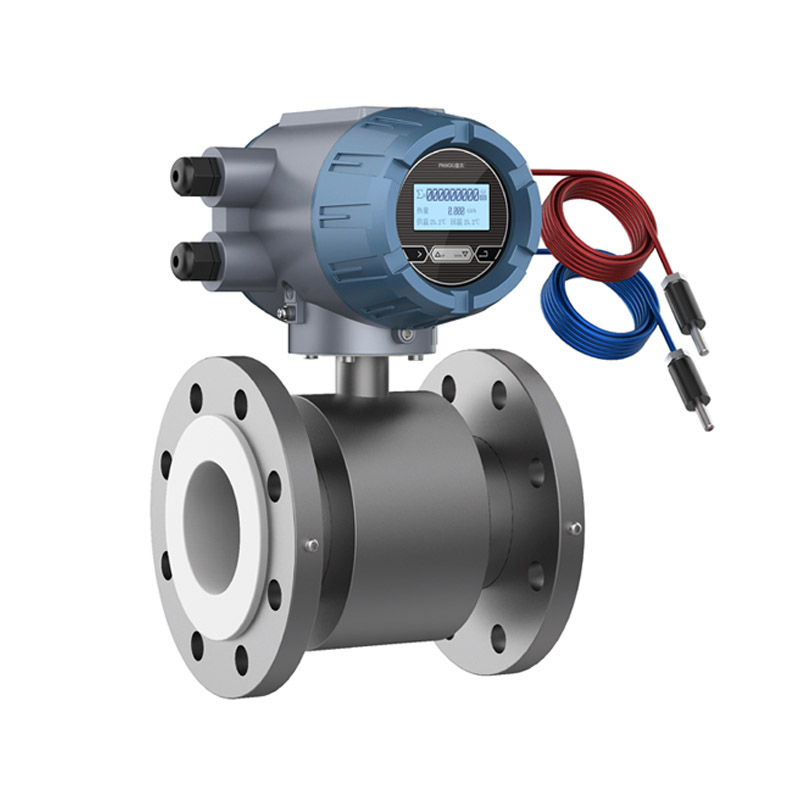 PMH Series Electromagnetic Thermal Energy MeterFor water-based heating and cooling, it calculates energy directly using matched Pt1000 sensors, avoiding a second meter and extra installation errors.View Product →
FAQ
Q1: Can an electromagnetic flow meter measure oil or diesel?
Generally no. Hydrocarbons sit well below the conductivity threshold, so the sensor cannot generate a usable signal. A positive displacement meter is the usual choice for clean oils and fuels.
Q2: Which type is better at low flow?
Mechanical, and specifically positive displacement. Electromagnetic accuracy falls off below roughly 0.3 m/s, which is why a small dosing line is rarely a good fit for one.
Q3: Do electromagnetic meters need straight pipe?
Yes. Five diameters upstream and three downstream is a common minimum, and the more restrictive the upstream fitting, the more length you should allow. Grounding faults cause more problems than piping layout in practice.
Q4: Can a mechanical meter be used on wastewater?
Only where the stream is already screened and free of fibres and grit. Turbines and displacement chambers both jam or erode when solids are present.
Q5: How often do the two need checking?
A mechanical meter drifts as it wears, so verification intervals are shorter and a rebuild is eventually expected. An electromagnetic meter is normally verified every one to two years, with the liner and electrodes inspected at the same time.
If you remember one rule from this comparison, make it this: match the principle to the fluid first, then argue about accuracy and price. A perfectly specified electromagnetic meter on a non-conductive oil line is worth nothing, and a mechanical meter on an abrasive slurry will be rebuilt long before it pays back its purchase price.
PREV:High Temperature Sanitary Magmeter: A Practical Selection Guide for Hygienic Lines
NEXT:What is an Industrial Paperless Recorder? The Unsung Hero of Modern Plant Data Acquisition
NEXT:What is an Industrial Paperless Recorder? The Unsung Hero of Modern Plant Data Acquisition
Interested in cooperation or have questions?
Contact Us Now!
Kelly

+86 13967196545

pangusales@vip.163.com
Production Base:

Building 1 and Building 42, No. 889 Huancheng North Road, Deqing County, Huzhou City, Zhejiang Province
Jiji
+86 15397010616
pgsalesjiji@vip.163.com

+86-0571-87770830
Corporate Headquarters:
602-702, Block D, Building 3, Area B,Xigang New Territories, 206 Zhenhua Road,Hangzhou City, Zhejiang Province, China

Copyright © Hangzhou Pangu Automation System Co., Ltd. Rights Reserved.
Custom Digital Panel Mount Industrial Instruments Suppliers
