 Read More

 Get A Quote

High Temperature Sanitary Magmeter: A Practical Selection Guide for Hygienic Lines
Home / News / Industry News / High Temperature Sanitary Magmeter: A Practical Selection Guide for Hygienic Lines
Product Category
NEW Category
Contact us
Contact Us
We specialise in the research, development and manufacture of electrical wires and cables.
 +86 13967196545
Related News
- Overcoming Flow Measurement Bottlenecks in Water Treatment: A Selection & Application Guide for Hangzhou Pangu’s Three Core Electromagnetic Flowmeters
- Electromagnetic Flow Meters: Pros, Cons, Selection Guide, and FAQs
- 3 Inch Steam Flow Meter: Selection Guide, Accuracy Tips and Best Practices
- Solving Flow Measurement Failures: High-Precision Electromagnetic Flowmeter for Harsh Industrial Applications
High Temperature Sanitary Magmeter: A Practical Selection Guide for Hygienic Lines
Content
- 1 What High Temperature Does to a Magmeter
- 2 Key Specifications for Hot Sanitary Service
- 3 Liner and Electrode Choices for a High Temperature Sanitary Magmeter
- 4 Remote Transmitter or Compact: Managing the Heat Path
- 5 Accuracy and Repeatability in Sanitary Batch Processes
- 6 Calibration: Start with a Verifiable Baseline
- 7 Installation Checklist for a Hot Sanitary Magmeter
- 8 Frequently Asked Questions
- 9 The Bottom Line for a Hot Sanitary Process
In most hygienic plants, a magmeter fails from the cleaning cycle long before the product wears it out. Hot caustic at 85°C, then an acid rinse, then high-temperature water – that thermal and chemical cycling stresses the wetted liner and electrodes harder than months of steady process flow. If your line carries a hot product, such as sugar syrup, fruit concentrate, or a pharmaceutical intermediate, and the CIP programme reaches 130°C or higher, the choice of a high temperature sanitary magmeter is not a minor detail. It is the difference between years of silent service and a failed seal a few months after commissioning.
A high temperature sanitary magmeter is not a special category of instrument. It is an electromagnetic flowmeter with liner and electrode materials chosen to withstand heat, plus an installation layout that keeps sensitive electronics away from the thermal source. When those choices are made correctly, the meter keeps the classic magmeter advantages: no moving parts, low pressure drop, ±0.3% to ±0.5% accuracy, and stable output through thousands of cleaning cycles.
What High Temperature Does to a Magmeter
An electromagnetic flowmeter works on Faraday's law. The sensor generates a magnetic field, and the flowing conductive liquid acts as a moving conductor. The induced voltage is proportional to the average velocity of the liquid. The principle is simple and stable. What limits the meter in hot service are the materials and the heat path.
The liner and the transmitter are the two failure points of a magmeter in hot process lines. Everything else is standard mechanical design.
The liner is the first barrier. General-purpose liners such as hard rubber, neoprene, and polyurethane are rated to about 80°C. Above that limit, a liner can soften, creep, or lose adhesion to the flow tube. When that happens, the insulating barrier breaks down, the signal becomes unstable, and the meter must be pulled from the line for re-engineering.
The second barrier is the transmitter electronics. Most transmitters carry an ambient rating of roughly 60°C. When a hot process pipe sits close to a compact magmeter, radiated heat can push the electronics beyond their specification. The output drifts, and in severe cases the circuit board is damaged.
Key Specifications for Hot Sanitary Service
The table below summarises the parameters that decide whether a magmeter will survive a high-temperature hygienic line. Review these before you approve a meter for procurement.
| Parameter | Typical Requirement | Why It Matters |
|---|---|---|
| Max continuous process temperature | 130–150°C | Wetted liner and seals must hold for the service life |
| CIP/SIP peak temperature | 150°C or higher | Cleaning cycles are the most aggressive thermal exposure |
| Liner material | PFA or PTFE | Withstands heat and caustic/acid cleaning chemicals |
| Electrode material | 316L, Hastelloy C-276, tantalum | Corrosion resistance at elevated cleaning temperatures |
| Accuracy | ±0.3% to ±0.5% of rate | Batch yield and recipe consistency depend on the values |
| Turndown ratio | 10:1 or better | Production lines run at variable flow rates |
| Enclosure rating | IP67 / IP69K | Hose-down and wet environments in food and pharma plants |
| Transmitter arrangement | Remote, or compact with heat isolation | Protects electronics from high pipe temperature |
Liner and Electrode Choices for a High Temperature Sanitary Magmeter
PFA remains the default liner for high-temperature sanitary lines
PFA (perfluoroalkoxy) combines a continuous working temperature around 180°C with strong resistance to the caustic and acid solutions used in CIP programmes. It also provides the smooth, non-stick surface that hygienic draining and product changeover require. PTFE can reach a slightly higher theoretical temperature, but its higher permeation rate allows hot acids and steam to migrate through the liner over time. In repeated thermal cycling, PFA is the more durable and predictable choice.
Match electrode material to the cleaning chemistry
Electrode selection is driven more by cleaning chemistry than by the product itself. At 85°C, a 2% caustic solution is aggressive to 316L, and a nitric acid pass is worse. Hastelloy C-276 is the common choice for CIP circuits that use nitric acid; tantalum or platinum substitutes are used when the product is sensitive to metal ions or when the environment is exceptionally corrosive. Whichever material you select, the electrodes should sit flush with the liner. Proud electrodes trap droplets and harbour residue, which defeats the purpose of a sanitary design.
 Pangu PMF High-Precision Electromagnetic Flowmeter for Sanitary LinesOffers 0.2% accuracy and robust construction for demanding measurement tasks. Its wetted materials can be selected for hot caustic or nitric acid CIP environments, making it a reliable choice where precision and chemical resistance are critical.View Product →
The high-precision electromagnetic flowmeter from Pangu is built for applications where measurement integrity matters. With wetted materials specified at the factory to suit your process medium and temperature, it is a strong candidate for a high temperature sanitary magmeter installation that demands tighter accuracy.
Remote Transmitter or Compact: Managing the Heat Path
When the process pipe surface temperature exceeds 60°C, a remote transmitter should be your first plan. The transmitter contains the CPU, analogue-to-digital converter, and display – none of which tolerate prolonged heat well. In a remote configuration, the sensor remains in the hot line while the transmitter is mounted on a wall, post, or nearby panel. That keeps the electronics within their ambient specification and makes the displayed values easy to read for operators.
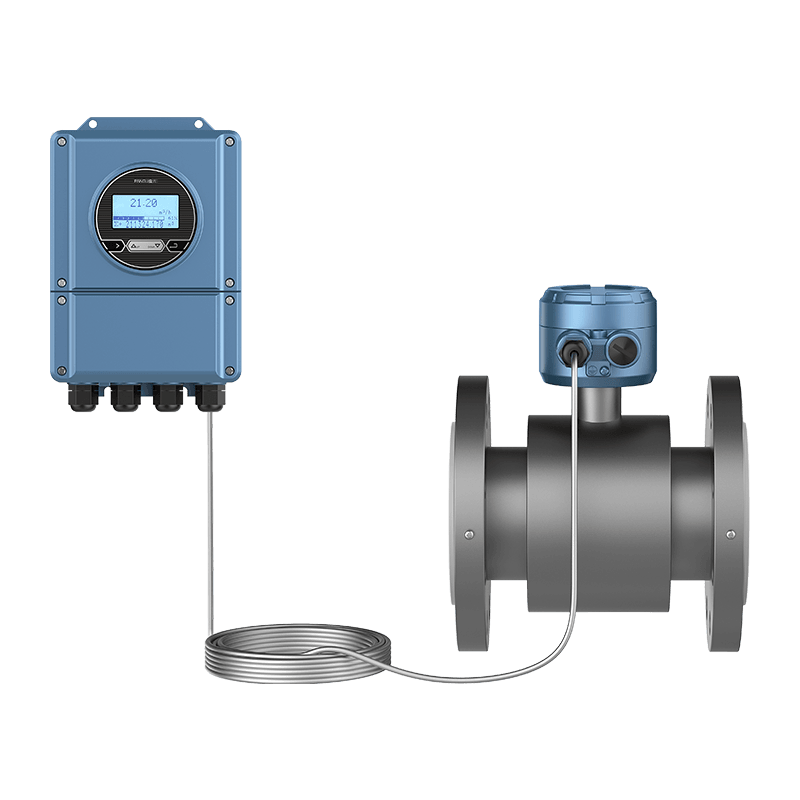
 Pangu PMF Split-Type Remote Electromagnetic FlowmeterSeparates the transmitter from the sensor for hot pipelines exceeding 60°C, protecting electronics from heat. With shielded cables and selectable distance, it suits plant layouts requiring remote display and reliable operation in demanding industrial conditions.View Product →
The split-type remote electromagnetic flowmeter is the practical answer for hot lines where the transmitter must be separated from the sensor. The distance between sensor and transmitter can be selected to suit the plant layout, and the signal cable is shielded for industrial environments.
A compact magmeter can still work on a hot line if the heat budget is managed. A thermal spacer beneath the transmitter, a sun shield, and careful insulation of the upstream pipe all help, but each adds complexity and cost. For a permanent high-temperature installation, remote is almost always the more robust choice.
Accuracy and Repeatability in Sanitary Batch Processes
Sanitary production is batch production. A fermentation vessel fills, reacts, and discharges; a blending skid sequences water, concentrate, and flavour; a CIP skid runs water, caustic, and acid in a fixed order. Every stage is tracked by a flow value, and errors accumulate through the batch. A meter with instability at zero or drift at high temperature will cost you more in reprocessing than any saving on the purchase order.
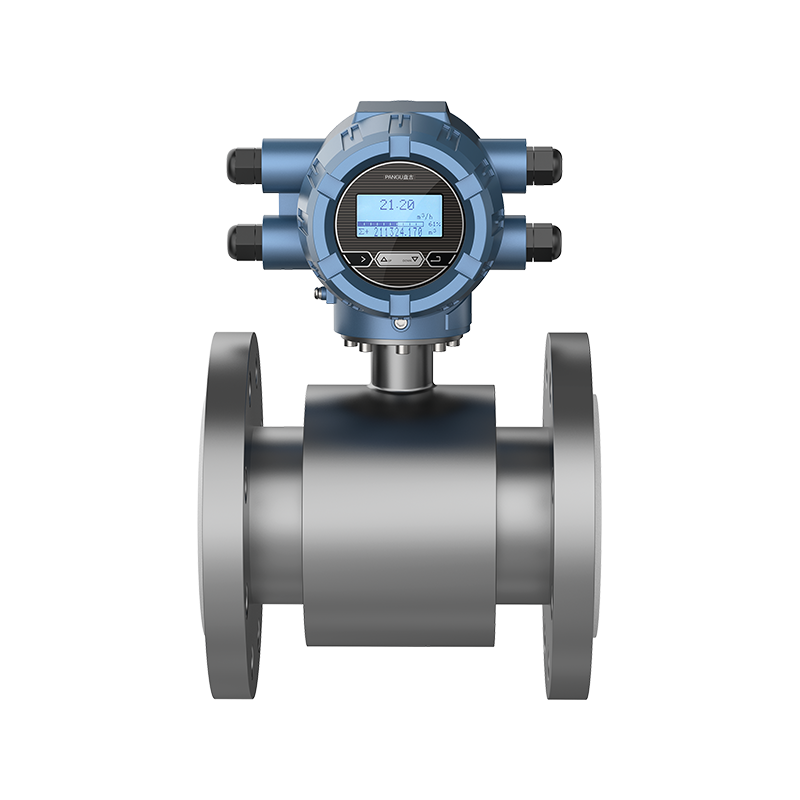
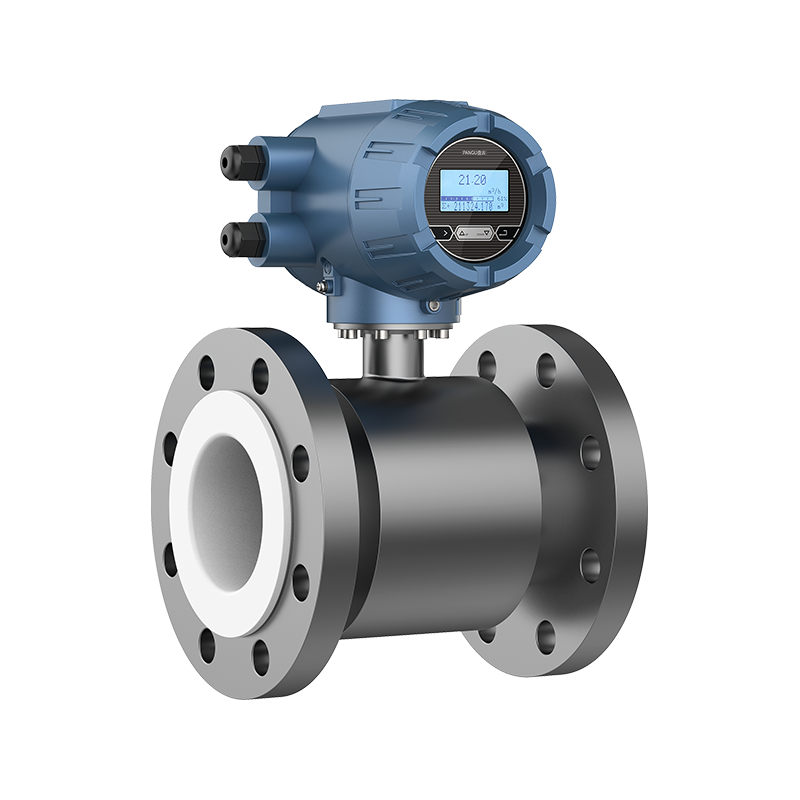 Pangu PMF Integrated Electromagnetic FlowmeterCombines sensor and transmitter in one compact body for moderate-temperature utility lines or skid-mounted systems. Its easy installation and accurate measurement help maintain batch consistency in water, CIP, or blending processes without excessive cost.View Product →
For a clean utility line or a skid-mounted application, the integrated electromagnetic flow meter is a straightforward solution. It combines the sensor and transmitter in one body, which reduces installation cost when the line temperature is moderate and the electronics can be kept away from the heat source.
As a practical note, the accuracy class of a magmeter is commonly ±0.3% to ±0.5% of rate, with repeatability typically around ±0.1%. Once the meter is calibrated for the actual operating range, the high process temperature will not change the calibration, because the velocity-based measurement is independent of fluid temperature, pressure, and viscosity.
Calibration: Start with a Verifiable Baseline
A high temperature sanitary magmeter will eventually be compared with something: a weigh scale, a tank level, or an upstream meter. If the factory calibration is trustworthy, the comparison works out. If not, you inherit a dispute that is expensive to resolve during production.
Pangu operates a flow calibration facility with three independent water lines covering DN15 to DN1000, using both standard meter and static mass methods. Every magmeter is verified before shipment against traceable equipment, and the calibration certificate travels with the instrument, which is worth reviewing on the factory page before you finalise a purchase.
Installation Checklist for a Hot Sanitary Magmeter
- Mount in a vertical riser with flow upward so the tube drains completely – needed for hygiene and for zero stability.
- Keep the meter away from the highest heat source, or insulate the adjacent pipe so radiant heat cannot reach the sensor.
- Respect the required upstream and downstream straight runs – typically 5 diameters upstream and 2 diameters downstream of a disturbance.
- Fit grounding rings or a grounding electrode; hot purified water and cleaning solutions can have low conductivity, so grounding is not optional.
- For remote transmitter models, route the signal cable away from motor starters, variable frequency drives, and power cables.
- Check that the flange gaskets are rated for the full CIP temperature; gaskets are one of the most common premature failure points.
Frequently Asked Questions
Q1: What is a sanitary magmeter?
A sanitary magmeter is an electromagnetic flow meter with hygienic wetted materials, smooth internal surfaces, and flush electrodes. It is designed to drain completely, withstand cleaning in place, and avoid harbouring product residues. It uses the same measurement principle as any other magmeter.
Q2: Can a magmeter handle steam sterilisation (SIP)?
Yes, within the liner limits. With a PFA or PTFE liner rated for the SIP temperature, and with the transmitter mounted away from the steam path, a magmeter can survive repeated steam sterilisation cycles. The practical ceiling for standard sanitary magmeters is about 150°C at the wetted parts.
Q3: Which liner is better for hot service – PFA or PTFE?
PFA is the safer choice for most CIP and SIP circuits. PTFE allows a slightly higher continuous temperature, but its permeability is higher, and in acid service it can gradually let the medium reach the meter body. PFA offers lower permeation, smoother surfaces, and better long-term adhesion under thermal cycling.
Q4: Compact or remote for a line that runs at 130°C?
Remote. The transmitter is the most heat-sensitive component, and at 130°C process temperature the compact form factor gives you very little margin. A remote transmitter also keeps the display readable and simplifies maintenance access.
Q5: What accuracy can I expect on a hot syrup line?
±0.3% to ±0.5% of rate is a realistic expectation for a properly specified and installed magmeter. Since the measurement is velocity-based, the accuracy does not change between 20°C and 130°C; what changes is the material selection, not the calibration.
The Bottom Line for a Hot Sanitary Process
Selecting a high temperature sanitary magmeter comes down to three decisions: the liner and electrode materials that will survive the worst cleaning cycle, the physical separation of electronics from the heat source, and the calibration evidence that comes with the instrument. Get those three right, and the meter will deliver stable, repeatable flow data for years. Get them wrong, and you will be exchanging flanges and hunting for faults during a production run.
The Pangu product range includes the high-precision, integrated, and remote split-type electromagnetic flowmeters described above, with materials specified to match your medium and temperature. If your process combines hygienic requirements with high cleaning temperatures, discuss the liner, electrode, and transmitter layout with a field application engineer before you place the order. The contact page is the right place to start that conversation.
PREV:Introduction: What is a Paperless Recorder?
NEXT:Electromagnetic vs Mechanical Flow Meters: How to Choose the Right One
NEXT:Electromagnetic vs Mechanical Flow Meters: How to Choose the Right One
Interested in cooperation or have questions?
Contact Us Now!
Kelly

+86 13967196545

pangusales@vip.163.com
Production Base:

Building 1 and Building 42, No. 889 Huancheng North Road, Deqing County, Huzhou City, Zhejiang Province
Jiji
+86 15397010616
pgsalesjiji@vip.163.com

+86-0571-87770830
Corporate Headquarters:
602-702, Block D, Building 3, Area B,Xigang New Territories, 206 Zhenhua Road,Hangzhou City, Zhejiang Province, China

Copyright © Hangzhou Pangu Automation System Co., Ltd. Rights Reserved.
Custom Digital Panel Mount Industrial Instruments Suppliers
