 Read More

 Get A Quote

Remote Electromagnetic Flowmeter vs. Compact Type: The Ultimate Industrial Guide
Home / News / Industry News / Remote Electromagnetic Flowmeter vs. Compact Type: The Ultimate Industrial Guide
Product Category
NEW Category
Contact us
Contact Us
We specialise in the research, development and manufacture of electrical wires and cables.
 +86 13967196545
Related News
- Electromagnetic Flow Meter vs. Vortex Flow Meter: Principles, Differences, and Selection Guide
- Electromagnetic Flowmeter Accuracy: Why Copper Coils Matter More Than Ever
- Insertion Electromagnetic Flowmeter Guide: Working Principle and Selection
- Electromagnetic vs Mechanical Flow Meters: How to Choose the Right One
Remote Electromagnetic Flowmeter vs. Compact Type: The Ultimate Industrial Guide
Content
- 1 Remote Electromagnetic Flowmeter vs. Compact Type: Why It's the Ultimate Choice for Industrial Flow Measurement
- 2 How It Works: The Core Principle of Electromagnetic Flow Meters
- 3 Why Choose a "Remote" Over a "Compact" Electromagnetic Flow Meter?
- 4 Key Technical Advantages of Remote Magnetic Flowmeters
- 5 Frequently Asked Questions
- 6 Conclusion: Empowering Future-Proof Industrial Automation
Remote Electromagnetic Flowmeter vs. Compact Type: Why It's the Ultimate Choice for Industrial Flow Measurement
In process industries such as chemical manufacturing, water treatment, metallurgy, and pharmaceuticals, precise flow monitoring is the nervous system that ensures operational safety and process stability. Among various industrial flow measurement technologies, the Remote Electromagnetic Flowmeter (also known as a remote magnetic flow meter) stands out as the ultimate solution for complex, harsh, and hard-to-reach environments.
If you are a plant manager, instrumentation engineer, or procurement specialist looking to optimize facility efficiency and equipment longevity, understanding the engineering benefits of a remote-type magnetic flow meter is essential.
How It Works: The Core Principle of Electromagnetic Flow Meters
At its engineering core, a remote electromagnetic flowmeter operates on Faraday's Law of Electromagnetic Induction. When a conductive fluid flows perpendicularly through a magnetic field inside the measuring tube, an induced voltage (electromotive force) is generated proportional to the fluid velocity.
Key Technical Advantage: The volumetric flow rate measurement is entirely independent of fluid temperature, pressure, density, viscosity, and (within acceptable limits) conductivity. This delivers true, linear high-precision data for critical industrial processes.
Why Choose a "Remote" Over a "Compact" Electromagnetic Flow Meter?
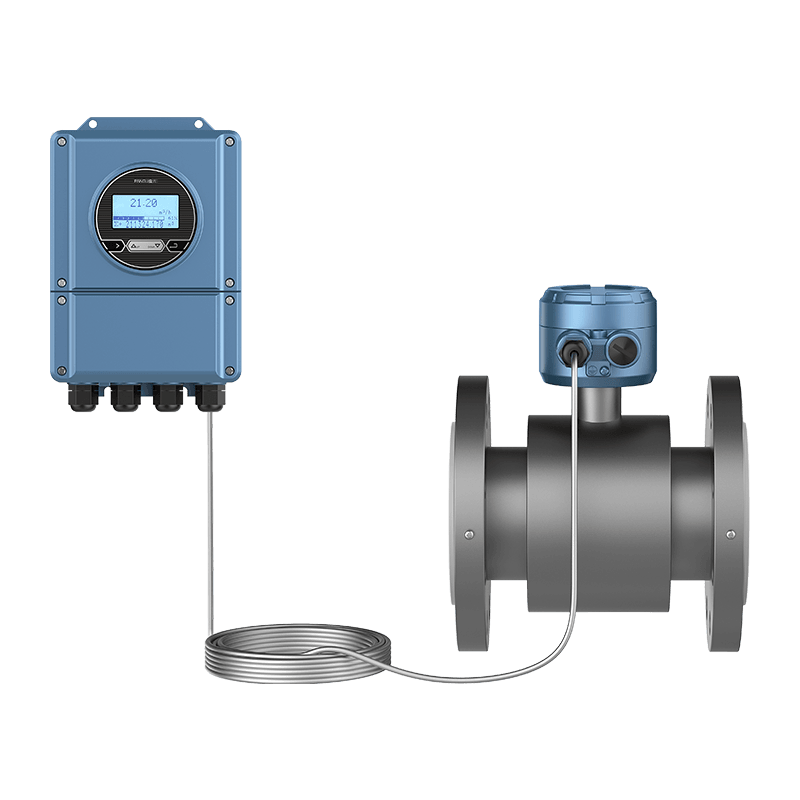
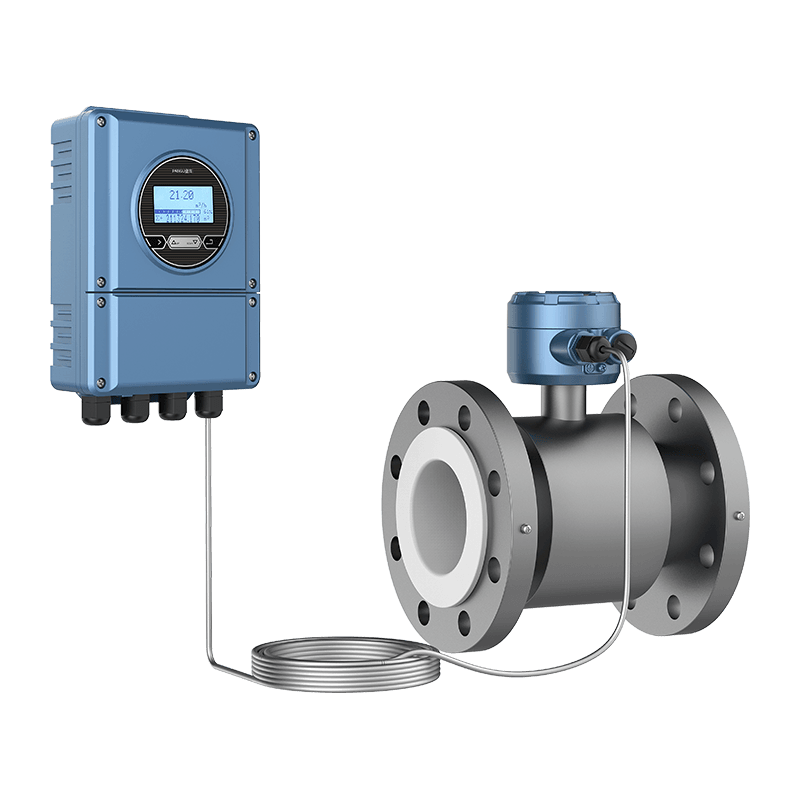
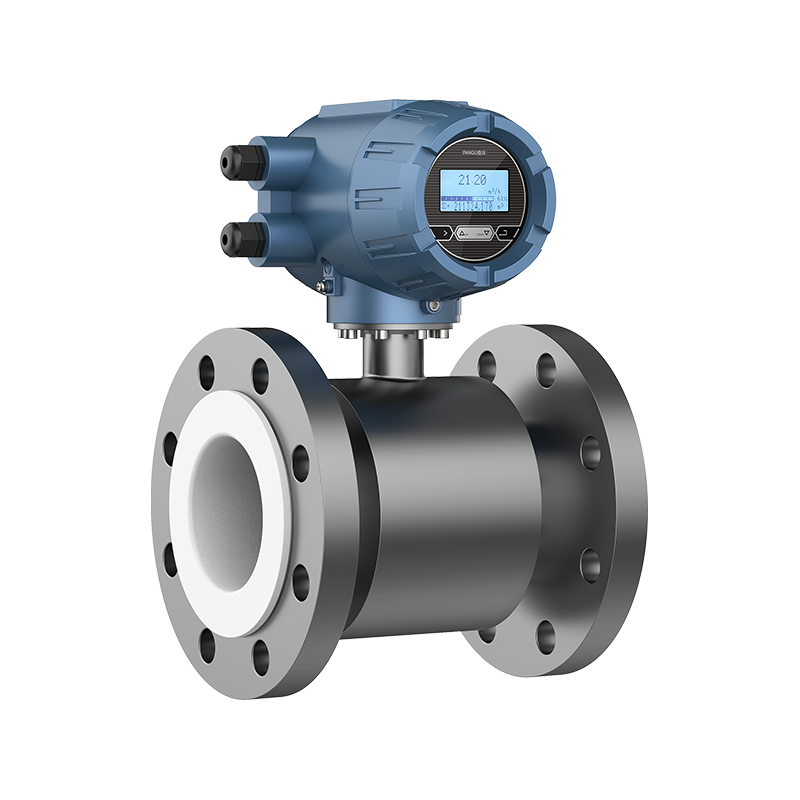
Electromagnetic flowmeters generally come in two architectural designs: compact (where the converter is mounted directly on top of the sensor) and remote (where the sensor and converter are separated by specialized signal cables).
Here is why industrial engineers frequently specify the remote configuration:
- Extreme Environment & Vibration Resilience: When pipelines are located in underground pits, high-altitude racks, high-temperature zones, or sub-merged areas, compact meters risk premature electronic failure due to heat, moisture, or heavy mechanical vibration. A remote setup allows the delicate electronic display and transmitter ("the brain") to be housed safely in a secure, climate-controlled control room or protected instrument cabinet.
- Safe & Effortless Maintenance: Routine calibration, parameter adjustments, and troubleshooting do not require technicians to climb high structures or enter hazardous confined spaces. All operations can be safely managed from ground level.
- Superior Signal Integrity over Long Distances: By utilizing high-grade shielded signal cables and advanced digital excitation technologies, remote-type flowmeters maintain signal purity even when the sensor is located hundreds of meters away from the control panel.
Key Technical Advantages of Remote Magnetic Flowmeters
- Zero Pressure Drop & Obstructionless Design: With no moving parts or flow restrictions inside the measuring tube, fluid flows seamlessly. This eliminates permanent pressure loss, significantly reduces pump energy consumption, and makes it ideal for abrasive slurries, high-viscosity fluids, wastewater, and solid-liquid mixtures.
- Wide Turndown Ratio & Bidirectional Measurement: Easily handles dramatic flow fluctuations, supporting forward, reverse, and net flow totalization with high accuracy.
- Versatile Lining and Electrode Options: From PTFE (poly tetra fluoro ethylene) and PFA linings to Hastelloy, Titanium, and Tantalum electrodes, it can be customized to resist aggressive acids, caustic alkalis, and corrosive chemicals.
Frequently Asked Questions
Q1: When should I choose a remote electromagnetic flowmeter instead of a compact type?
A: You should choose a remote type when the installation site involves extreme temperatures, heavy vibrations, immersion risks (underground pits), hazardous atmospheres, or when the measuring point is physically difficult for operators to access safely.
Q2: Does the signal cable length affect the accuracy of a remote magnetic flowmeter?
A: Yes, cable length and capacitance can impact weak electrode signals. It is crucial to use manufacturer-certified, high-grade double-shielded signal cables and stay within the specified maximum distance limits (usually up to 100 or 200 meters depending on fluid conductivity).
Q3: Can remote electromagnetic flow meters measure non-conductive liquids?
A: No. Like all magnetic flow meters, the fluid being measured must have a minimum electrical conductivity (typically 5μS/cm) to satisfy Faraday's Law. They cannot measure pure hydrocarbons, oils, or deionized water effectively.
Conclusion: Empowering Future-Proof Industrial Automation
As global industries and smart water management systems advance, reliable data acquisition remains the cornerstone of operational efficiency. The remote electromagnetic flowmeter offers the durability, precision, and architectural flexibility required to keep modern industrial plants running safely and efficiently.
Let’s Connect & Discuss:
In your plant or engineering projects, do you lean toward compact or remote flowmeters? What are the toughest environmental challenges you’ve faced with flow instrumentation? Let’s share insights in the comments below!
In your plant or engineering projects, do you lean toward compact or remote flowmeters? What are the toughest environmental challenges you’ve faced with flow instrumentation? Let’s share insights in the comments below!
PREV:What is an Industrial Paperless Recorder? The Unsung Hero of Modern Plant Data Acquisition
NEXT:Digital Flow Transmitter Selection Guide: How to Choose an Electromagnetic Flowmeter
NEXT:Digital Flow Transmitter Selection Guide: How to Choose an Electromagnetic Flowmeter
Interested in cooperation or have questions?
Contact Us Now!
Kelly

+86 13967196545

pangusales@vip.163.com
Production Base:

Building 1 and Building 42, No. 889 Huancheng North Road, Deqing County, Huzhou City, Zhejiang Province
Jiji
+86 15397010616
pgsalesjiji@vip.163.com

+86-0571-87770830
Corporate Headquarters:
602-702, Block D, Building 3, Area B,Xigang New Territories, 206 Zhenhua Road,Hangzhou City, Zhejiang Province, China

Copyright © Hangzhou Pangu Automation System Co., Ltd. Rights Reserved.
Custom Digital Panel Mount Industrial Instruments Suppliers
