 Read More

 Get A Quote

Electromagnetic Flowmeter Accuracy: Why Copper Coils Matter More Than Ever
Home / News / Industry News / Electromagnetic Flowmeter Accuracy: Why Copper Coils Matter More Than Ever
Product Category
NEW Category
Contact us
Contact Us
We specialise in the research, development and manufacture of electrical wires and cables.
 +86 13967196545
Related News
- Why Is Your Electromagnetic Flow Meter Signal Unstable, and How Do You Fix Slurry Coating and Grounding Issues?
- Why Do Water Flow Meters Lose Accuracy and How Can You Fix Them?
- Why Does an Electromagnetic Flow Meter Show Flow in an Empty Pipe? (Causes & Troubleshooting)
- Pangu Electromagnetic Flowmeters Cover Six Critical Industries, Enabling Process Control and Energy Savings
Electromagnetic Flowmeter Accuracy: Why Copper Coils Matter More Than Ever
Content
In a process plant, flow measurement is the eyes of the operation. When those numbers start jumping around, operators lose confidence in everything downstream — dosing, batching, billing, and yield. Yesterday, our after-sales team received a report we hear more often than we should: a customer's DN1000 electromagnetic flowmeter was giving unstable readings, with flow values fluctuating up and down despite no corresponding change in the process.
The meter in question was not manufactured by Hangzhou Pangu. We went to the site anyway.
A call we hear more often than we should
Our engineers arrived on site and ran through the diagnostics with the customer's team: instantaneous flow readings, repeatability tests, and a linearity check across the operating range. The symptoms told a consistent story — the meter's magnetic field was not behaving as it should.
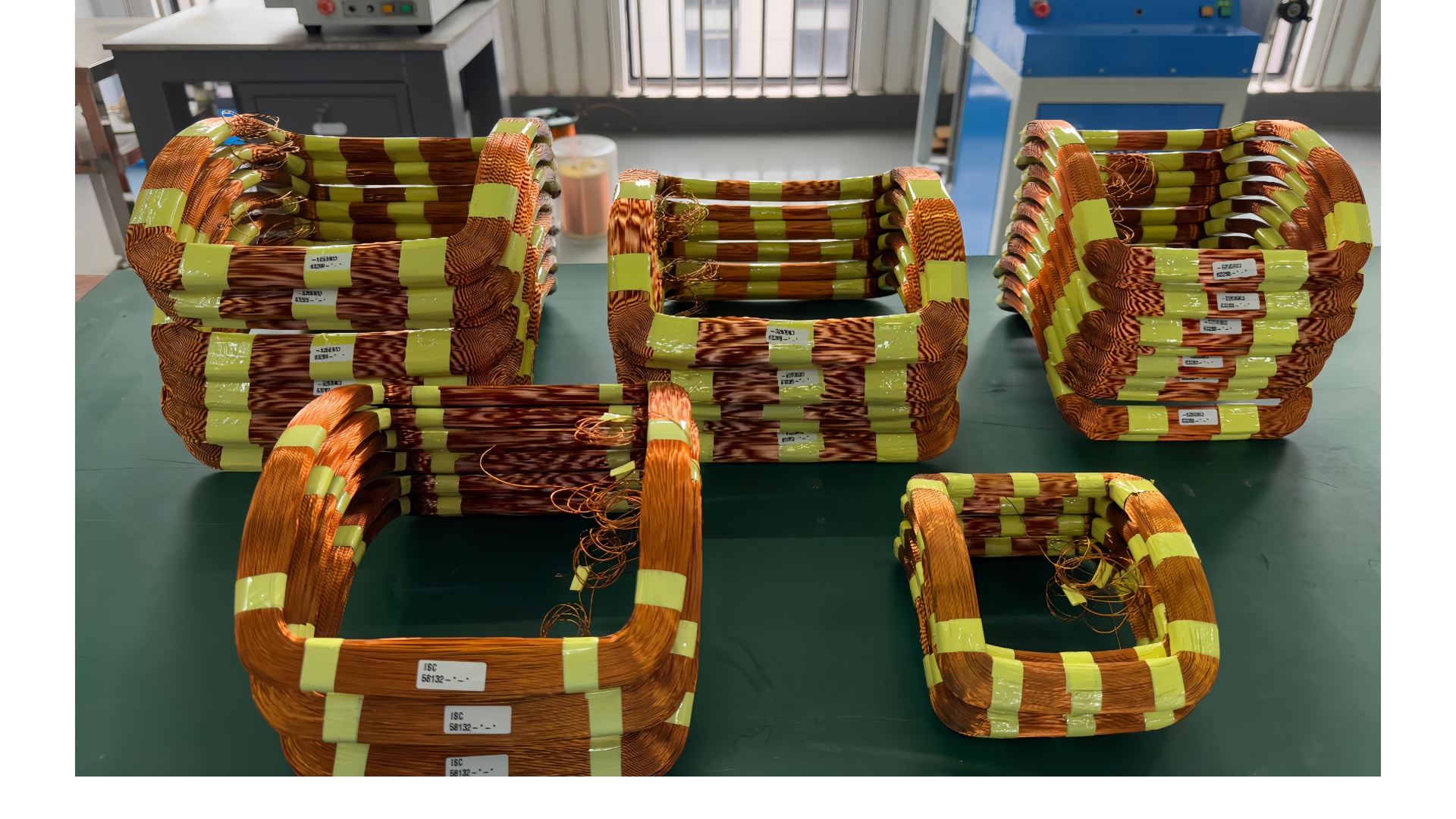
When the protective layer around the coil was peeled back, the answer was plain to see. The coil inside was aluminum, not copper. The supplier of this DN1000 had quietly substituted the material to cut cost. From the outside, the meter looked completely normal.
The diagnosis: three symptoms, one cause
The three things a process engineer cares about most in any flowmeter are:
- Accuracy — how close the reading is to the true flow.
- Repeatability — whether the same flow gives the same reading, run after run.
- Linearity — whether the output scales predictably across the entire flow range.
In an electromagnetic flowmeter, all three depend on the same component: the excitation coil. An electromagnetic flowmeter works on Faraday's law of induction — it generates a magnetic field across the pipe and measures the voltage induced as a conductive liquid flows through it. The coil creates that field, which means coil quality sets the ceiling on the meter's performance.
Why the coil sets the ceiling on performance
Copper and aluminum coils look identical inside a closed meter, but they are not equivalent. Aluminum has only about 60% of copper's electrical conductivity, and the two metals behave differently as temperature changes. In a large-bore meter like a DN1000 — where the coil is physically large and the magnetic field must stay uniform across a 1000 mm pipe — that difference is magnified: a weaker field, higher electrical losses, and a field whose strength drifts with operating temperature.
The practical result is a meter that looks right on the calibration bench but loses accuracy, repeatability and linearity in real service — exactly the unstable readings this customer was seeing.
The quiet driver: a 50% copper price rise
Why would a supplier make this substitution? The economics are straightforward. Copper prices have risen by roughly 50% year over year, and the coil is one of the heaviest material items in an electromagnetic flowmeter. For manufacturers under cost pressure, switching to aluminum is an easy, invisible way to protect margins.
The trap for buyers: from the outside, the two coils are indistinguishable. Unless someone opens the meter and looks, the substitution can go unnoticed for years — until the flow data can no longer be trusted.
How to tell copper from aluminum
There is a simple field check. Strip back the protective layer around the coil:
- Aluminum — silvery-white in color.
- Copper — reddish-brown in color.
If the meter cannot be opened on site, protect yourself at the purchasing stage instead:
- Require coil material to be stated explicitly in the specification and the purchase order.
- Ask for the manufacturer's material certificates and coil inspection records.
- Ask how accuracy, repeatability and linearity are tested — and guaranteed — across the operating temperature range.
- If a meter's readings start drifting or turning nonlinear after months of service, check the coil before anything else.
Our position: copper, always
We have seen what an unstable flowmeter costs a plant: mis-dosed chemicals, off-spec batches, unscheduled downtime, and months of untrustworthy data. Measured against any of those, the price difference between a copper coil and an aluminum coil is trivial. We know what the coil does in an electromagnetic flowmeter, which is why Hangzhou Pangu insists on copper coils in every meter we build — no exceptions.
Frequently asked questions
Why does coil material affect electromagnetic flowmeter accuracy?
The coil generates the magnetic field that every flow reading depends on. A lower-conductivity material like aluminum produces a weaker, less stable field, which degrades accuracy, repeatability and linearity — especially in large-bore meters.
How can I tell if my flowmeter has aluminum coils instead of copper?
Remove the protective layer around the coil: aluminum appears silvery-white, copper appears reddish-brown. If you cannot open the meter, request the coil material specification and material certificates from the supplier before purchase.
Why are some flowmeter manufacturers switching from copper to aluminum coils?
Copper prices are up roughly 50% year over year, and coils are one of the largest material items in a flowmeter. Substituting aluminum cuts material cost — but the savings come out of the meter's long-term performance.
Does Hangzhou Pangu use copper or aluminum coils?
Copper. In every electromagnetic flowmeter we manufacture.
PREV:Electromagnetic Flow Meters: Pros, Cons, Selection Guide, and FAQs
NEXT:Why Is Your Electromagnetic Flow Meter Signal Unstable, and How Do You Fix Slurry Coating and Grounding Issues?
NEXT:Why Is Your Electromagnetic Flow Meter Signal Unstable, and How Do You Fix Slurry Coating and Grounding Issues?
Interested in cooperation or have questions?
Contact Us Now!
Kelly

+86 13967196545

pangusales@vip.163.com
Production Base:

Building 1 and Building 42, No. 889 Huancheng North Road, Deqing County, Huzhou City, Zhejiang Province
Jiji
+86 15397010616
pgsalesjiji@vip.163.com

+86-0571-87770830
Corporate Headquarters:
602-702, Block D, Building 3, Area B,Xigang New Territories, 206 Zhenhua Road,Hangzhou City, Zhejiang Province, China

Copyright © Hangzhou Pangu Automation System Co., Ltd. Rights Reserved.
Custom Digital Panel Mount Industrial Instruments Suppliers
