 Read More
 Get A Quote

Why Do Water Flow Meters Lose Accuracy and How Can You Fix Them?
Home / News / Industry News / Why Do Water Flow Meters Lose Accuracy and How Can You Fix Them?
Product Category
NEW Category
Contact us
Contact Us
We specialise in the research, development and manufacture of electrical wires and cables.
 +86 13967196545
Related News
- How Do You Choose the Right Magnetic Flow Meter for Your Process Fluid?
- The Backbone of Water Utility Operations: Why Flow Accuracy Drives Modern Municipal Networks
- Mastering Wastewater Flow: The Engineering, Selection, and Maintenance of Electromagnetic Flow Meters
- How to Choose a Flow Meter That Survives Aggressive Chemical Service
Why Do Water Flow Meters Lose Accuracy and How Can You Fix Them?
Content
- 1 Why Water Systems Keep Losing Accuracy at the Meter
- 2 How an Inline Water Meter Reads Flow Without Moving Parts
- 3 Choosing Industrial Flow Meters for Corrosive Liquids
- 4 Where Remote Sensor Electromagnetic Water Meters Solve Access Problems
- 5 Handling Low-Conductivity Streams With Demineralized Water Mag Meters
- 6 Electromagnetic vs Other Flow Measurement Instruments for Water Service
- 7 Digital Output and the Shift Toward Networked Water Flowmeters
- 8 Installation and Maintenance Practices That Protect Accuracy
- 9 Frequently Asked Questions
- 9.0.1 Q1: Can one electromagnetic meter handle both raw water and low-conductivity condensate?
- 9.0.2 Q2: How much does liner choice actually affect service life on corrosive lines?
- 9.0.3 Q3: Is a remote transmitter design less accurate than a compact, integrated meter?
- 9.0.4 Q4: Do electromagnetic meters need periodic recalibration like mechanical meters?
- 9.0.5 Q5: What is the biggest mistake buyers make when selecting a water flow meter?
- 9.0.6 Q6: Can digital output be added to an existing installation later?
Why Water Systems Keep Losing Accuracy at the Meter
Most plant operators do not think about their water flow meter until a batch fails quality control or a utility bill spikes without explanation. By the time the discrepancy is traced back to the instrument, the root cause is usually one of a small set of recurring issues: a liner that has started to degrade, a sensor that cannot cope with low-conductivity fluid, or a transmitter mounted somewhere no one can reasonably service it. These are not exotic failure modes. They are the ordinary, predictable ways that Flow Measurement Instruments lose reliability over years of continuous service.
The pattern repeats across sectors that otherwise have little in common. A food and beverage plant tracking rinse water usage, a district heating utility billing by volume, and a semiconductor fabrication line monitoring ultrapure water all depend on the same underlying assumption: that the number on the totalizer reflects what is actually moving through the pipe. When that assumption breaks down quietly, over months rather than in a single dramatic failure, the cost shows up as wasted chemical dosing, mis-billed customers, or a failed regulatory audit long before anyone suspects the instrument itself.
The chart below summarizes reported causes of measurement error across water-handling installations, based on field service patterns commonly documented by instrumentation maintenance teams. Corrosion-related liner and electrode wear leads the list, followed closely by errors tied to low-conductivity fluid and cable or distance limitations on remote installations. None of these causes are difficult to prevent once they are understood, which is exactly why specification and installation planning deserve more attention than they typically receive.
Instruments that sit closest to the process fluid tend to fail for chemical reasons; instruments that sit far from the process tend to fail for electrical reasons. Matching the meter to both conditions, not just one, is what keeps a water flowmeter reading accurately for a decade rather than a season.
How an Inline Water Meter Reads Flow Without Moving Parts
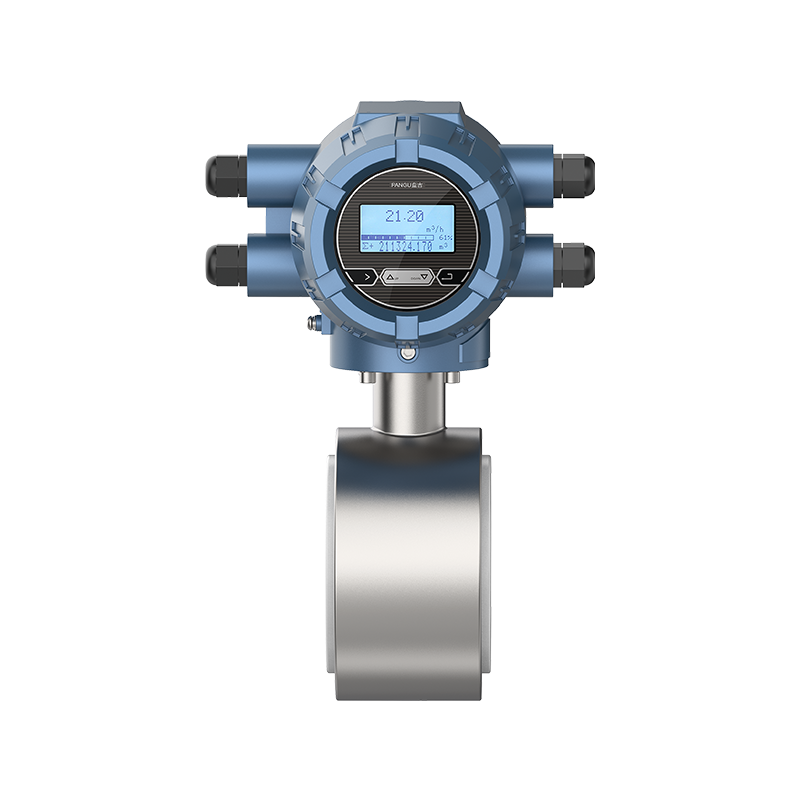
An electromagnetic flow meter for water works on a straightforward principle: a conductive liquid moving through a magnetic field generates a voltage that is proportional to how fast the liquid is moving. There are no impellers, turbines, or orifice plates in the wetted path, which is precisely why this measurement approach has become the default choice for clean, dirty, and chemically active water streams alike. The lack of moving parts removes an entire category of wear-related failure that mechanical meters cannot avoid.
The practical value of this design shows up in daily operation. A digital water meter built on the electromagnetic principle does not lose accuracy as internal components wear, does not require lubrication, and does not create the pressure drop associated with constriction-based designs. That last point matters for pumping cost: a mechanical in line water meter with a restrictive bore can add measurable head loss across a distribution network, while an electromagnetic sensor with a full, unobstructed bore does not.
Because the signal generated is a direct function of liquid velocity across the full cross-section, these instruments handle a wide velocity range well, which is one reason water flow meters based on this principle are specified across residential distribution, industrial process water, and wastewater lines within the same product family.
Choosing Industrial Flow Meters for Corrosive Liquids
Water is rarely just water. Cooling loops carry treated water with biocides, process lines carry acidic or caustic rinse water, and wastewater lines carry a shifting mixture of solids and dissolved chemicals. Selecting a meter for this kind of service means looking past the headline accuracy figure and focusing on what actually touches the fluid: the liner material and the electrode material.
| Liner Material | Typical Service | Notable Trait |
|---|---|---|
| PTFE | Acidic and caustic process water | Broad chemical compatibility |
| PFA | High-purity and aggressive media | Strong temperature tolerance |
| Ceramic | Abrasive slurry water | High wear resistance |
| Rubber | Neutral raw and potable water | Cost-effective for mild duty |
| Polyurethane | Abrasive, low-chemical duty | Good abrasion tolerance |
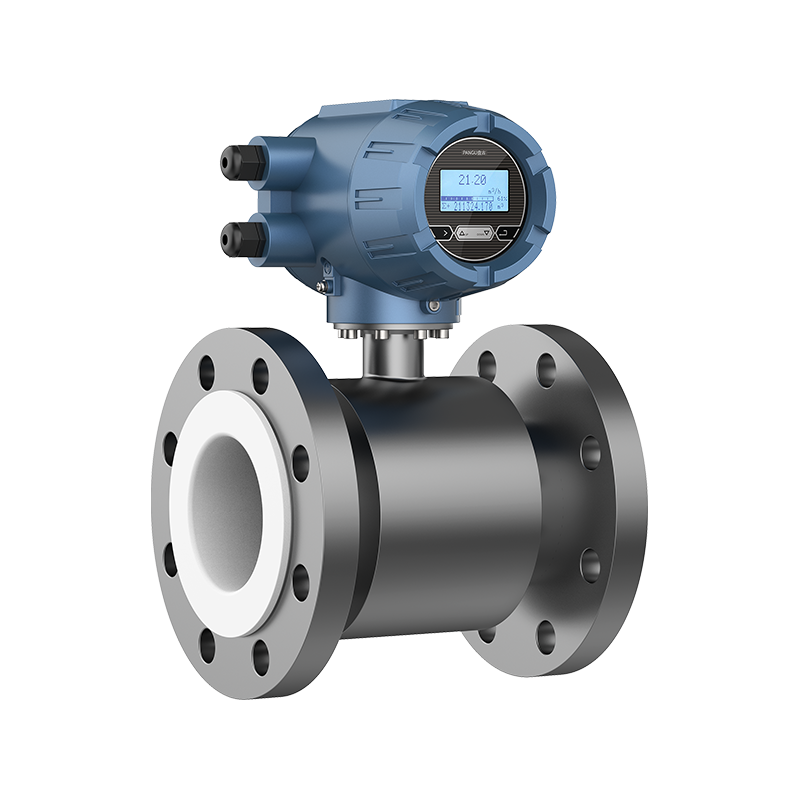
For lines carrying acids, alkalis, or chloride-rich rinse water, a fluoropolymer liner paired with a corrosion-resistant electrode alloy is the practical baseline. Ceramic-lined designs earn their place in abrasive slurry service where mechanical wear, not chemical attack, is the dominant threat. The right combination lets a single flowmeter for water stay in calibration through years of chemically demanding duty rather than needing liner replacement every service interval.
Where Remote Sensor Electromagnetic Water Meters Solve Access Problems
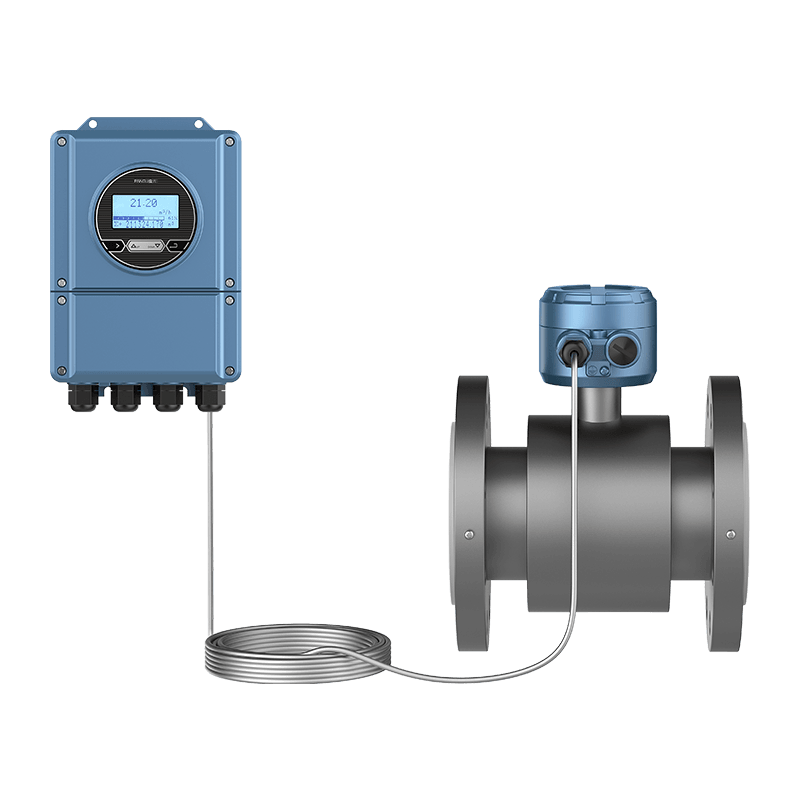
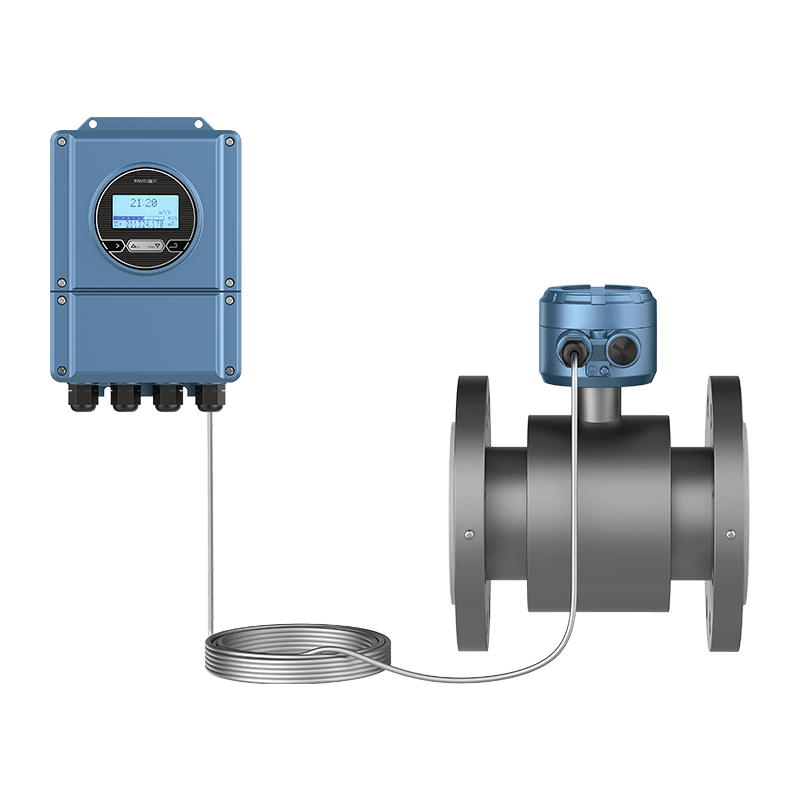
Not every measurement point is easy to reach. Underground vaults, submerged pump stations, confined pipe galleries, and high-temperature jacketed lines all share the same problem: a conventional compact meter puts the display and electronics somewhere they cannot be safely read or serviced. A split-configuration design separates the sensing element in the pipeline from the converter and display, connected by a signal cable, so the readout can be mounted at a height and location a technician can actually access.
This separation is not just a convenience feature. It changes how the instrument survives its environment. The sensor body, rated for submersion or high ambient moisture, stays in the vault or trench, while the converter stays dry, ventilated, and within reach for calibration checks. For utilities managing distribution networks, this is often the difference between a meter that gets inspected on schedule and one that gets ignored because reaching it requires confined-space entry procedures.
Confined Space Friendly Submersible Sensor Option Extended Cable Runs
Cable length is the main design constraint to plan around. Signal integrity over longer distances depends on shielded cable and, in many designs, a low-frequency excitation mode that resists interference. Utilities planning a remote installation should confirm the maximum supported cable run for their specific site before finalizing conduit routing, since retrofitting a longer path after installation is far more disruptive than accounting for it up front.
Handling Low-Conductivity Streams With Demineralized Water Mag Meters
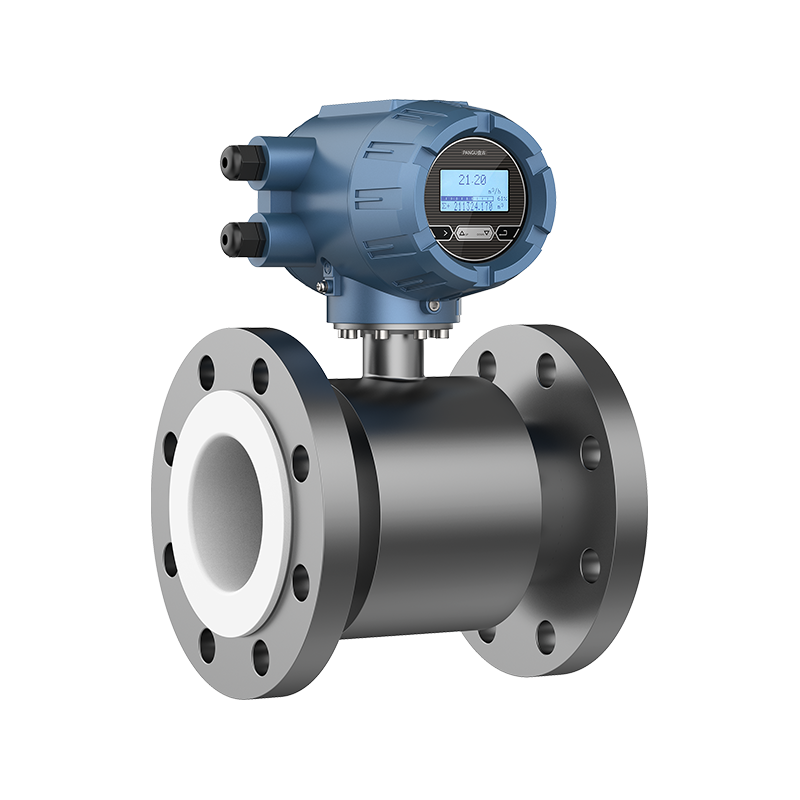
Standard electromagnetic meters rely on the liquid carrying enough dissolved ions to generate a clean, measurable signal. Demineralized water, deionized water, and condensate return streams often fall below the conductivity threshold that a general-purpose sensor needs to hold a stable reading. In power generation, semiconductor rinse lines, pharmaceutical water systems, and boiler feed applications, this is not a rare edge case; it is the normal operating fluid.
Meters purpose-built for this duty use modified electrode design, higher-impedance signal processing, and excitation frequencies tuned to pull a usable signal out of a fluid with minimal ionic content. The result is stable flow rate monitoring for water that would otherwise produce a noisy or drifting output on a standard sensor. Getting this specification wrong is a common and expensive mistake: installing a general-purpose meter on a demineralized loop typically shows up months later as unexplained totalizer drift rather than an immediate failure, which makes it harder to trace.
| Application | Typical Conductivity Range | Meter Requirement |
|---|---|---|
| Potable distribution | Moderate to high | Standard electromagnetic design |
| Boiler feed / condensate | Very low | Low-conductivity signal processing |
| Semiconductor rinse water | Extremely low | High-impedance electrode design |
Electromagnetic vs Other Flow Measurement Instruments for Water Service
Electromagnetic sensing is not the only option for measuring water, and it is worth being direct about where it wins and where an alternative technology may fit better. Ultrasonic meters avoid wetted electrodes entirely and handle low conductivity without special design, but clamp-on versions can be sensitive to pipe condition and air entrainment. Mechanical turbine and vortex meters remain common where budget is the primary constraint, though bearing wear and pressure loss become long-term maintenance items.
Electromagnetic Ultrasonic Turbine / Vortex
The pattern that emerges is consistent across field data: electromagnetic sensing offers the strongest balance of accuracy, low maintenance, and zero pressure loss for conductive water streams, while mechanical designs trail on long-term stability once bearings and moving parts begin to wear. For residential and industrial water meters alike, this balance is why electromagnetic technology has become the default recommendation whenever the fluid is conductive enough to support it.
Digital Output and the Shift Toward Networked Water Flowmeters
Utilities and industrial sites are steadily moving away from meters that only display a local total. A modern water pipeline flow measurement point is expected to output pulse, 4 to 20 milliamp, or fully digital protocol data that feeds directly into a supervisory system, enabling leak detection, demand forecasting, and remote billing without a site visit.
This shift changes what buyers should look for beyond raw accuracy. A meter with flexible output options, whether pulse, analog, or a digital field protocol, protects the investment as monitoring infrastructure evolves. It also simplifies tracking water flow velocity trends over time rather than relying on periodic manual readings that miss short-term variation entirely.
Installation and Maintenance Practices That Protect Accuracy
Even a well-specified water flowmeters installation can underperform if basic placement and upkeep rules are ignored. The following practices consistently show up in reliable, long-service installations:
- Maintain the manufacturer-recommended straight upstream and downstream pipe runs to avoid velocity profile distortion
- Keep the sensor fully flooded at all times; partial fill readings are a leading cause of reported inaccuracy
- Verify grounding rings or grounding electrodes are correctly installed, especially on non-conductive pipe
- Schedule periodic zero-flow verification rather than waiting for a visible discrepancy
- Inspect liner condition during any planned shutdown on corrosive or abrasive service lines
| Maintenance Item | Suggested Interval |
|---|---|
| Zero-flow calibration check | Annually |
| Grounding continuity check | Every 2 years |
| Liner visual inspection | During scheduled shutdown |
| Cable and connector inspection | Annually |
Treating these checks as routine, rather than reactive, is what keeps a flow meter for water within its stated accuracy band for its full service life instead of drifting quietly until a billing dispute or a failed audit forces the issue.
Frequently Asked Questions
Q1: Can one electromagnetic meter handle both raw water and low-conductivity condensate?
Generally no. Standard designs are tuned for typical raw and potable water conductivity, while low-conductivity service needs a sensor with modified electrode and signal processing designed specifically for that range.
Q2: How much does liner choice actually affect service life on corrosive lines?
Significantly. A liner mismatched to the process chemistry can degrade within months, while a correctly matched fluoropolymer or ceramic liner can last the full service life of the installation under the same conditions.
Q3: Is a remote transmitter design less accurate than a compact, integrated meter?
No. Accuracy is determined by the sensor and signal processing, not by cable length, provided the cable run stays within the rated maximum and shielding is installed correctly.
Q4: Do electromagnetic meters need periodic recalibration like mechanical meters?
They generally hold calibration longer because there are no wearing moving parts, but periodic zero-flow verification is still recommended to catch grounding or liner issues early.
Q5: What is the biggest mistake buyers make when selecting a water flow meter?
Specifying based on pipe size and budget alone, without confirming fluid conductivity, chemical compatibility, and installation access requirements up front.
Q6: Can digital output be added to an existing installation later?
In many cases the converter can be upgraded or replaced independently of the sensor, but confirming compatibility before purchase avoids a full sensor replacement later.
PREV:Engineering Guide to Electromagnetic Energy Meters in District Energy & HVAC Systems
NEXT:Hangzhou Pangu Electromagnetic Flowmeters in Salt Lake Lithium Extraction
NEXT:Hangzhou Pangu Electromagnetic Flowmeters in Salt Lake Lithium Extraction
Interested in cooperation or have questions?
Contact Us Now!
Kelly

+86 13967196545

pangusales@vip.163.com
Production Base:

Building 1 and Building 42, No. 889 Huancheng North Road, Deqing County, Huzhou City, Zhejiang Province
Jiji
+86 15397010616
pgsalesjiji@vip.163.com

+86-0571-87770830
Corporate Headquarters:
602-702, Block D, Building 3, Area B,Xigang New Territories, 206 Zhenhua Road,Hangzhou City, Zhejiang Province, China

Copyright © Hangzhou Pangu Automation System Co., Ltd. Rights Reserved.
Custom Digital Panel Mount Industrial Instruments Suppliers
