 Read More
 Get A Quote

Electromagnetic Flow Meter vs. Vortex Flow Meter: Principles, Differences, and Selection Guide
Home / News / Industry News / Electromagnetic Flow Meter vs. Vortex Flow Meter: Principles, Differences, and Selection Guide
Product Category
NEW Category
Contact us
Contact Us
We specialise in the research, development and manufacture of electrical wires and cables.
 +86 13967196545
Related News
- 3 Inch Steam Flow Meter: Selection Guide, Accuracy Tips and Best Practices
- Mastering Wastewater Flow: The Engineering, Selection, and Maintenance of Electromagnetic Flow Meters
- Why Is Your Electromagnetic Flow Meter Signal Unstable, and How Do You Fix Slurry Coating and Grounding Issues?
- Overcoming Flow Measurement Bottlenecks in Water Treatment: A Selection & Application Guide for Hangzhou Pangu’s Three Core Electromagnetic Flowmeters
Electromagnetic Flow Meter vs. Vortex Flow Meter: Principles, Differences, and Selection Guide
Content
In the realm of industrial automation and process control, Electromagnetic Flow Meters (Magmeters) and Vortex Flow Meters are two of the most widely implemented technologies for flow measurement.
While both instruments serve the primary purpose of calculating fluid flow within pipelines, they rely on fundamentally different operating principles, mechanical designs, and media compatibility. Selecting the wrong type can lead to inaccurate measurements, frequent downtime, or instrument failure.
This guide provides an in-depth comparison of their principles, key differences, and practical selection criteria to help you make an informed decision.
1. Operating Principles Compared
Electromagnetic Flow Meter: Faraday's Law of Induction
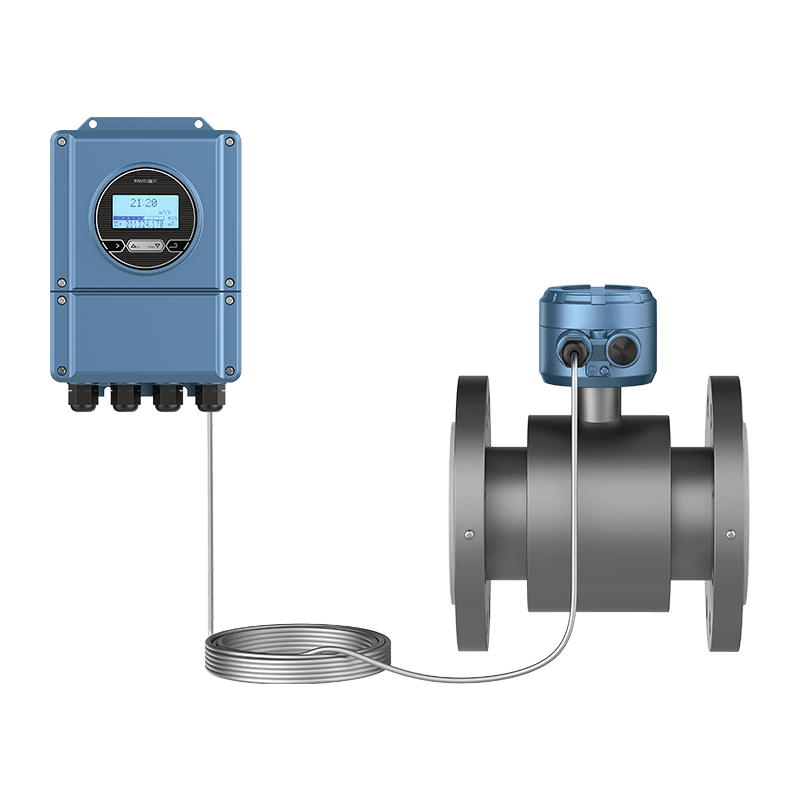
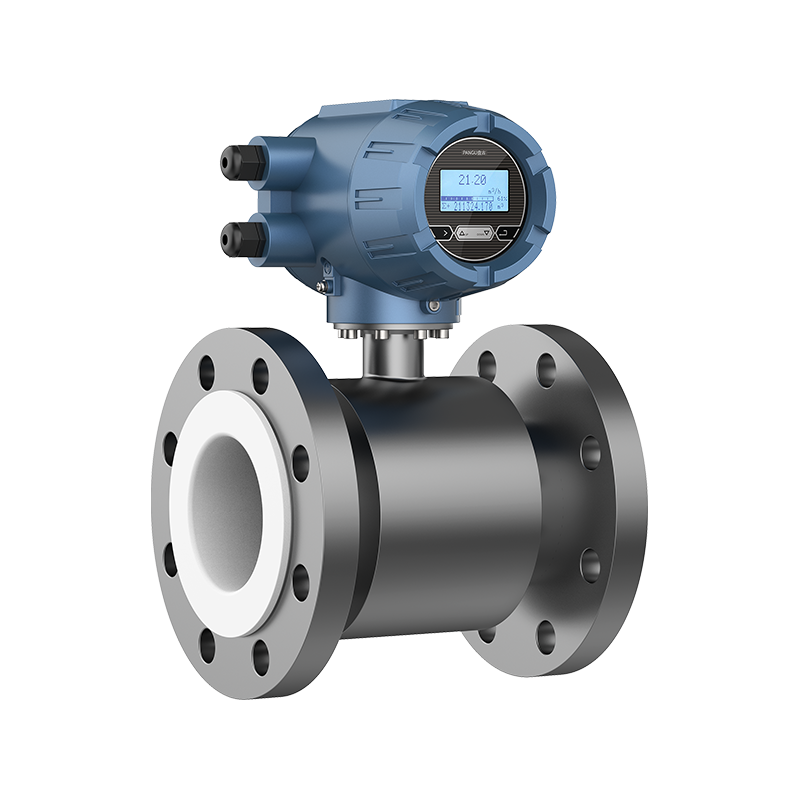
Electromagnetic flow meters operate under Faraday's Law of Electromagnetic Induction:
-
As a conductive fluid moves through a magnetic field generated perpendicular to the flow direction, it induces an electromotive force (voltage) E across two electrodes installed in the pipe wall:E = B .D. V
-
-
Key Requirement: The measured medium must be conductive (typically requiring a minimum conductivity of > 5uS/cm).
-
Advantage: The flow tube has a smooth, unobstructed bore with no moving parts, resulting in zero pressure drop.
Vortex Flow Meter: Von Kármán Effect
Vortex shedding flow meters utilize the Von Kármán Vortex Street Principle:
-
A non-streamlined obstruction (known as a shedder bar or bluff body) is placed inside the pipe. As fluid flows past this body, alternating vortices are shed on downstream sides.
-
The frequency f at which these vortices are shed is directly proportional to the average flow velocity V. A sensor detects these pressure pulses to compute volumetric flow.
-
Key Requirement: The fluid must maintain a minimum flow velocity (Reynolds number > 20,000). Conductivity is not required.
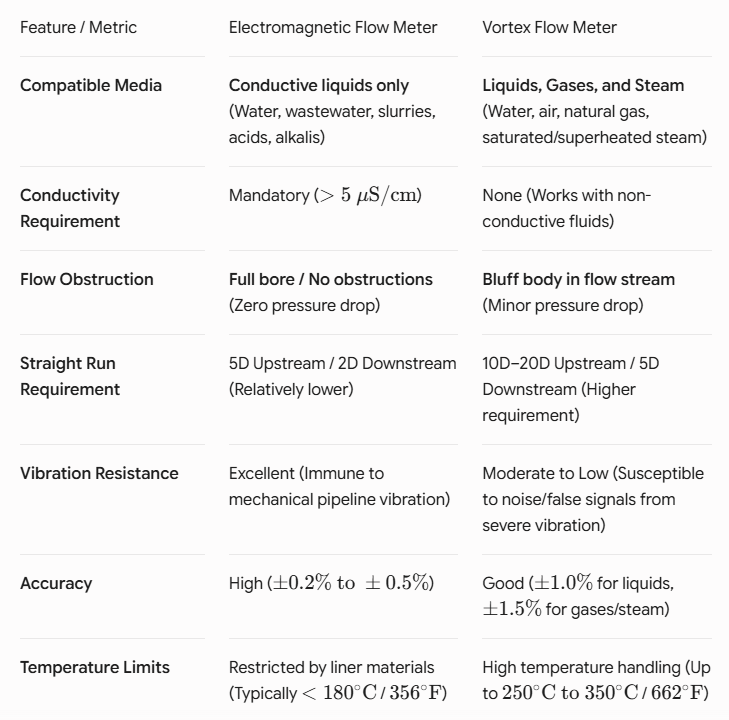
-
3. Application Scenarios & Selection Strategy
When choosing between a magmeter and a vortex flow meter, evaluate your application against these guidelines:
Choose an Electromagnetic Flow Meter if:
-
Measuring Corrosive or Slurry-laden Liquids: Excellent for municipal wastewater, mining slurries, paper pulp, and chemical acids. The unobstructed liner prevents clogging and severe abrasion.
-
Low Pressure Drop is Essential: Ideal for large municipal water mains and gravity-fed systems where pumping energy must be minimized.
-
Severe Pipeline Vibration is Present: Magmeters use electronic sensing across static magnetic fields, making them unaffected by mechanical vibrations.
Choose a Vortex Flow Meter if:
-
-
-
Measuring Steam or Gas: Vortex meters are the industry standard for measuring saturated steam, superheated steam, compressed air, or natural gas.
-
Measuring Non-Conductive Fluids: Essential for demineralized water, pure condensate, hydrocarbons, and organic solvents.
-
High Temperature / High Pressure Processes: Excellent performance in thermal fluid systems and high-temperature utility lines exceeding magmeter liner limits.
4. Frequently Asked Questions (FAQ)
Q1: Can an electromagnetic flow meter measure pure or deionized water?
No. Pure water and deionized water have extremely low conductivity (below $5\ \mu\text{S/cm}$). Without sufficient free ions, no detectable voltage signal can be induced. A Vortex Flow Meter or Ultrasonic Flow Meter should be used instead.
Q2: Why does pipeline vibration impact vortex meter accuracy?
Vortex meters rely on piezoelectric sensors to detect subtle pressure fluctuations caused by vortex shedding. Strong mechanical vibration in the pipe can mimic these pressure changes, causing the transmitter to output false high-flow readings.
-
-
-
PREV:How to Choose a Flow Meter That Survives Aggressive Chemical Service
NEXT:Applications of Paperless Recorders in Industrial Automation
NEXT:Applications of Paperless Recorders in Industrial Automation
Interested in cooperation or have questions?
Contact Us Now!
Kelly

+86 13967196545

pangusales@vip.163.com
Production Base:

Building 1 and Building 42, No. 889 Huancheng North Road, Deqing County, Huzhou City, Zhejiang Province
Jiji
+86 15397010616
pgsalesjiji@vip.163.com

+86-0571-87770830
Corporate Headquarters:
602-702, Block D, Building 3, Area B,Xigang New Territories, 206 Zhenhua Road,Hangzhou City, Zhejiang Province, China

Copyright © Hangzhou Pangu Automation System Co., Ltd. Rights Reserved.
Custom Digital Panel Mount Industrial Instruments Suppliers
