 Read More

 Get A Quote

Electromagnetic Flow Meter Applications Across Water, Chemical and Slurry Lines
Home / News / Industry News / Electromagnetic Flow Meter Applications Across Water, Chemical and Slurry Lines
Product Category
NEW Category
Contact us
Contact Us
We specialise in the research, development and manufacture of electrical wires and cables.
 +86 13967196545
Related News
- Why Is Your Electromagnetic Flow Meter Signal Unstable, and How Do You Fix Slurry Coating and Grounding Issues?
- Magnetic Water Flow Meter Buyer's Guide: Types, Accuracy, and Applications
- Electromagnetic Flow Meter vs. Vortex Flow Meter: Principles, Differences, and Selection Guide
- Electromagnetic Flow Meters: Pros, Cons, Selection Guide, and FAQs
Electromagnetic Flow Meter Applications Across Water, Chemical and Slurry Lines
Content
- 1 The Application Envelope: What a Mag Meter Can and Cannot Measure
- 2 Water Supply and Wastewater: The Largest Application Group
- 3 Chemical Processing and Aggressive Media
- 4 Slurry, Mining, Dredging and Thickened Sludge
- 5 HVAC, Chilled Water and Heat Metering
- 6 Other Applications Where the Technology Fits Well
- 7 Installation Checks That Prevent Most Field Failures
- 8 FAQ: Common Questions About Mag Meter Applications
A DN300 mag meter on a plant's sewage line starts reading about 12 percent high after roughly 18 months in service. The electronics are usually fine. In most cases the liner has swollen, grease has coated the electrodes, or the pipe runs only partly full at low flow. That one pattern explains most of what breaks in electromagnetic flow meter applications: the measuring principle is simple and stable, but the application conditions decide whether the reading stays trustworthy.
The conclusion first. Electromagnetic flow meters are the default choice for almost any conductive liquid or slurry: drinking water, municipal wastewater, chemical reagents, pulp stock, mineral slurry, chilled water and district heating water. They are the wrong choice for hydrocarbons, gases, steam and liquids below roughly 5 µS/cm conductivity. Everything that follows is about matching the liner, electrode, grounding and installation to the specific line the meter will sit on.
Start with the fluid, not the meter. Conductivity, abrasiveness, temperature, solids content and whether the pipe stays full eliminate more candidate meters than accuracy class ever does.
The Application Envelope: What a Mag Meter Can and Cannot Measure
A mag meter works on Faraday's law: a conductive liquid moving through a magnetic field generates a voltage proportional to its velocity, and the meter multiplies that velocity by the known pipe area to get flow. Because nothing protrudes into the stream, the meter adds essentially no pressure drop, and there are no moving parts to wear on clean liquids.
5 µS/cmTypical minimum conductivity for a standard mag meter to hold a stable signal
0.5–10 m/sWorking velocity window, with best accuracy usually between 1 and 3 m/s
DN15–DN1000Sizing and wet-calibration span covered on Pangu's automatic water flow rig
±0.2%–±0.5%Typical accuracy class under reference conditions for industrial models
Inside that envelope the practical limits are full pipe, a reasonably homogeneous fluid, and enough straight pipe upstream of the sensor. Partially full pipes, slug flow and entrained air produce the classic mag meter symptom: a reading that swings with the pump cycle instead of following real demand.
Outside the envelope, standard models will not measure deionized water at around 0.05 µS/cm, hydrocarbon fuels, steam or gas. Low-conductivity versions extend the lower limit for purified and semi-conductive liquids, and steam or gas metering moves to a different sensing technology paired with a flow computer.
Water Supply and Wastewater: The Largest Application Group
Water and wastewater is where mag meters face the least competition. Treatment plants meter raw water, settled and filtered water, process water, backwash lines and chemical dosing streams. Utilities meter supply mains and secondary supply pump stations. Sewerage operators meter raw sewage, return sludge and final effluent.
The fluid is conductive, usually single phase and rarely above 40 °C, so the default build is a hard rubber or EPDM liner with 316L stainless steel electrodes. Three design rules matter more than the accuracy class:
- Keep the normal velocity between 1 and 3 m/s. Below about 0.5 m/s, grit and rags settle and the signal drifts; above 4 m/s, abrasion on the liner accelerates.
- Fit grounding rings or a grounding electrode on plastic-lined or plastic-bodied pipework, and ground both ends. This single omission causes more erratic wastewater readings than electrode wear.
- Use empty-pipe detection on pumping mains that can drain down, so the meter reports zero instead of amplifying noise.
For lines carrying rags, grit and grease, the sizing and installation rules behind sewage flow measurement are worth checking before the meter is ordered, because a change of liner or a shift of one pipe diameter upstream is far cheaper at the drawing stage than after commissioning.
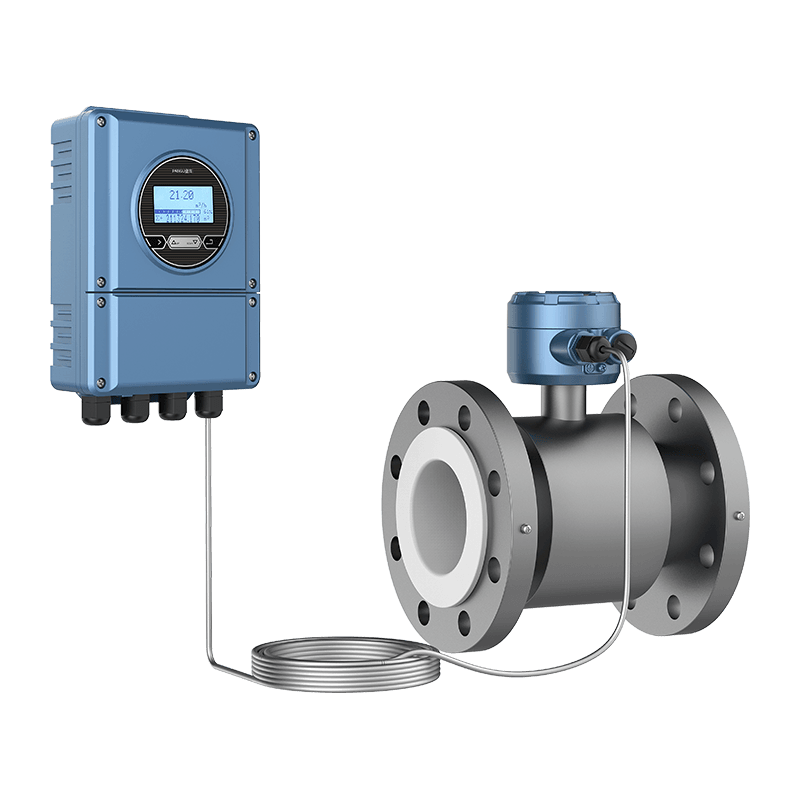
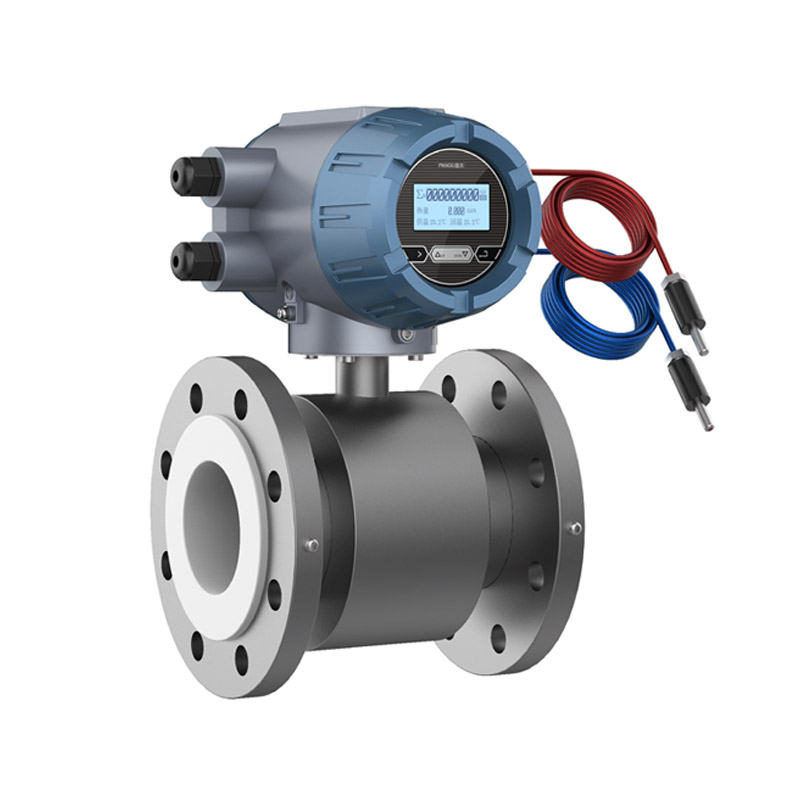
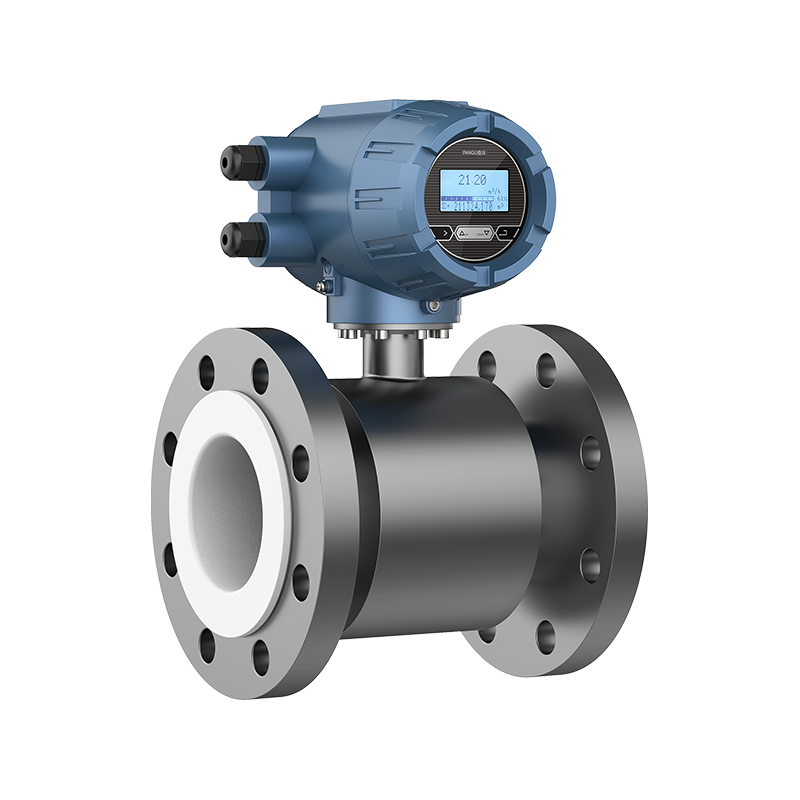
Where a meter replaces a mechanical water meter inside a confined pump station, an integrated electromagnetic flow meter keeps the converter mounted on the sensor body and removes the separate cabinet plus its cable run.
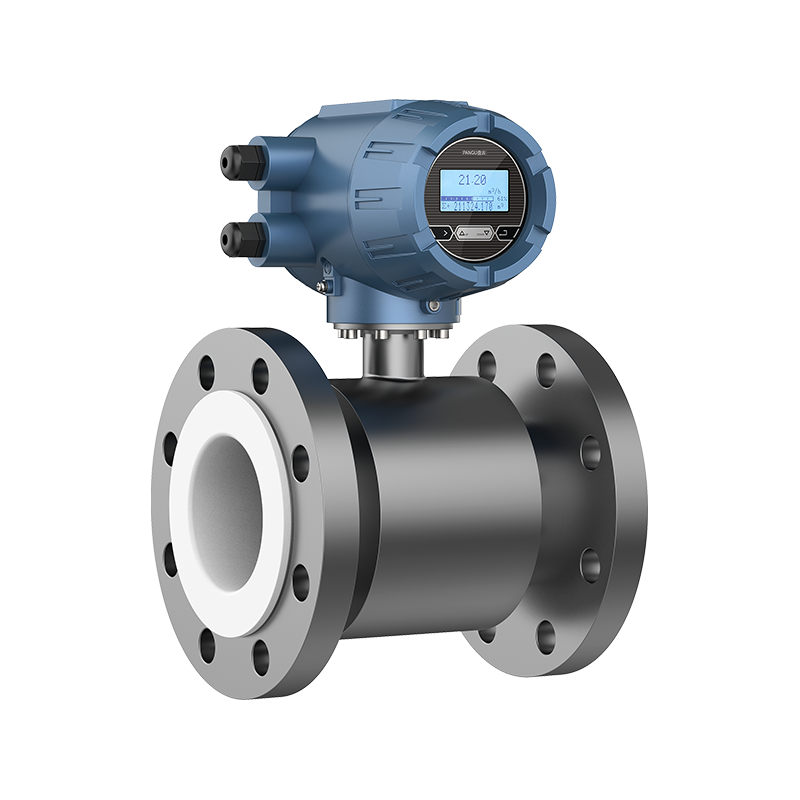 Integrated Electromagnetic Flow Meter PMF-GIntegrated design eliminates separate cabinet for confined pump stations; measures conductive liquids with selectable liners and electrodes for chemical compatibility.View Product →
Chemical Processing and Aggressive Media
Chemical plants use mag meters for acids, caustics, salt solutions, slurries and dosing lines, because a full-bore sensor handles solids and viscous products that would foul a turbine or Coriolis tube. The application question shifts from conductivity to material compatibility, and it must be answered with the liner manufacturer's chemical resistance data at the actual concentration and temperature, not with a general rule of thumb.
| Fluid group | Typical liner | Typical electrode |
|---|---|---|
| Water, wastewater, dilute acids | Hard rubber or EPDM | 316L stainless steel |
| Strong acids, oxidizers, chlorinated media | PTFE or PFA | Hastelloy C or tantalum |
| Caustic and hygienic liquids | PFA | Titanium or platinum |
| Abrasive mineral slurry | Polyurethane or ceramic | Tungsten carbide |
Two material limits catch people out. Rubber liners collapse in vacuum service, so PFA is the safe choice on lines that can be pulled under vacuum. And a PTFE-lined meter rated to 180 °C still fails if the flange gaskets or the adjacent piping are rated lower, so compare the full temperature chain, not just the sensor.
Slurry, Mining, Dredging and Thickened Sludge
Abrasion is the dominant failure mode here, and it is a cost per ton question rather than a measurement question. Polyurethane liners suit fine to medium slurries such as tailings, lime milk and thickened sludge; ceramic liners are reserved for coarse ore and high-solids dredging where the impact angle is unfavourable.
Velocity control does more for liner life than material selection alone. Running a slurry line at 1 to 2.5 m/s keeps solids suspended without hammering the liner, while sustained operation above 4 m/s can halve service life. Because the sensor is full bore, the meter never becomes the narrowest point in the line, which also avoids the blockage risk that comes with intrusive meters.
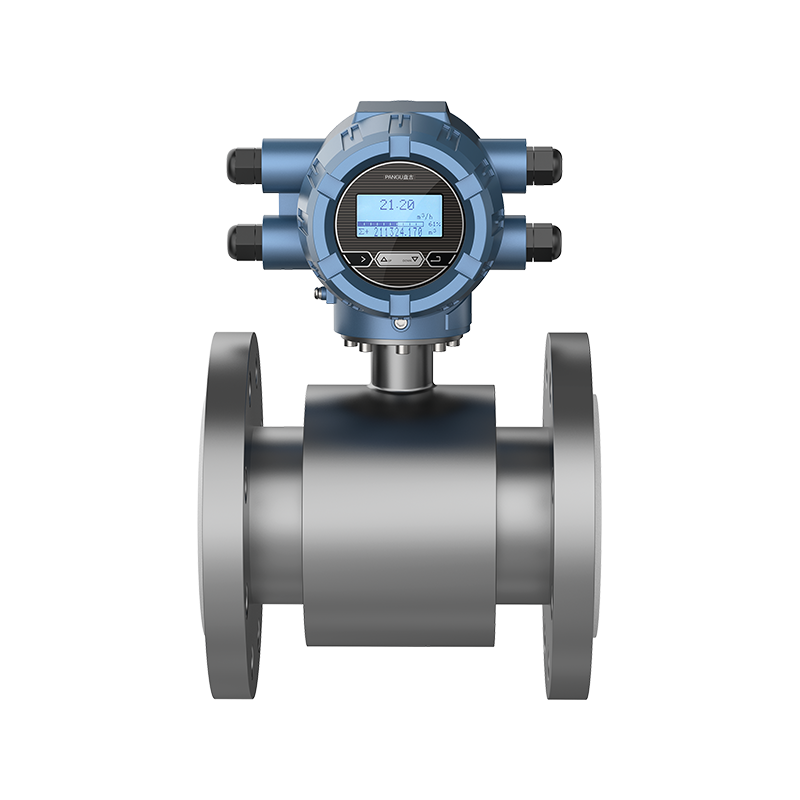
 Slurry Type Electromagnetic Flowmeter PMF-SHandles slurries with up to 30% solids using 25 Hz excitation and filtering; full-bore design avoids blockage in abrasive lines.View Product →
HVAC, Chilled Water and Heat Metering
In building air conditioning, refrigeration plants and district heating networks, the mag sensor is paired with matched temperature sensors on supply and return to become an electromagnetic heat meter. Flow accuracy is only half of the energy calculation.
Temperature uncertainty dominates at small differentials. At a 5 K supply-to-return differential, a 0.2 K error in the matched sensor pair is already around 4 percent of the heat reading, before any flow error is added. That is why heat meters should be ordered with factory-matched pairs, installed with equal immersion depth on both lines, and insulated so that ambient heat does not bias the return sensor.
Typical applications include district heating substations, chilled water loops, condenser water and thermal storage tanks, where one device replaces a separate flow meter plus a heat calculator.
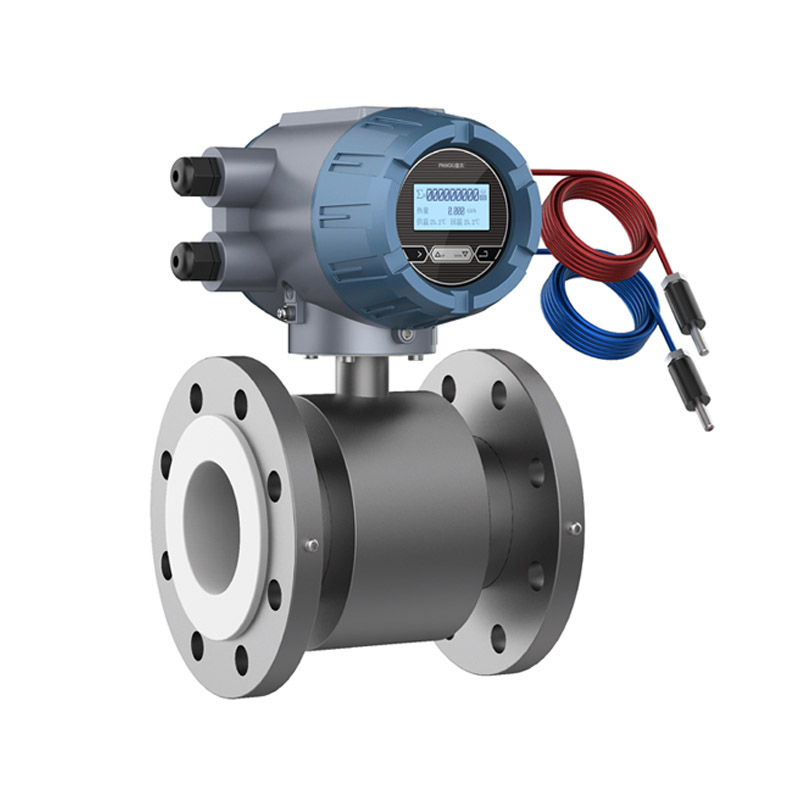 Pangu PMH Electromagnetic Thermal Energy MeterCombines flow and temperature measurement for heating/cooling systems, replacing separate flow meter and heat calculator; accuracy class 2%, Pt1000 sensors.View Product →
Other Applications Where the Technology Fits Well
Several further applications follow the same physics and rarely need special engineering:
- Pulp and paper: stock, white water and coating colour lines, where the full-bore design tolerates fibre and filler.
- Food and beverage: hygienic liners and polished electrodes for CIP circuits, milk, brine and syrups.
- Power generation: cooling water, circulating water and flue-gas desulphurization slurry.
- Textile and printing: dyeing and washing lines, where water intake and effluent discharge both need verifiable totals.
- Irrigation and agriculture: pumped mains and fertigation lines with high solids content.
Installation Checks That Prevent Most Field Failures
Most reported "faulty meters" turn out to be installation or application issues. Work through this list before calling it a sensor problem:
- Confirm conductivity with a sample and confirm the pipe runs full at minimum flow.
- Allow at least 5 pipe diameters upstream and 3 downstream; increase this after control valves, twin bends or pumps.
- Ground the sensor properly, using grounding rings on non-conductive pipework.
- Check the normal velocity lands between 1 and 3 m/s, and note the minimum velocity at night-time demand.
- Plan for electrode cleaning on greasy, scaling or biofilm-forming fluids; a removable or flushable design saves shutdown time.
- Verify zero on a full, static pipe after installation and again after the first month.
If the meter displays flow when the pump is stopped, the diagnosis usually starts with a partially empty pipe, entrained air, a stray current path or a wrong zero. A walkthrough of these cases appears in this note on a mag meter showing a reading with no flow.
FAQ: Common Questions About Mag Meter Applications
Q1: Can a standard mag meter measure deionized or demineralized water?
No. Below roughly 5 µS/cm the induced signal becomes too small for a standard converter to distinguish from noise. Low-conductivity models extend the limit, but the achievable accuracy and the required grounding must be confirmed against the actual water quality.
Q2: How much straight pipe does a mag meter really need?
Plan for at least 5 pipe diameters upstream and 3 downstream. After a control valve, a partly closed gate valve or two out-of-plane bends, double the upstream figure, or relocate the sensor to a quieter section of the line.
Q3: Why does the reading drop at low flow overnight?
Low-flow drift is usually a velocity problem, not a meter problem. Below about 0.3 m/s, coating, minor air entrainment and electrode polarization all distort the signal. If the line genuinely idles at that velocity, size the meter one step smaller to raise the velocity into a measurable range.
Q4: Are mag meters used for steam or gas?
No. Steam and gas require a different primary element, typically paired with a flow computer for pressure and temperature compensation. Mag meters appear in that picture only on liquid and heat energy circuits, in the form of electromagnetic heat meters.
The pattern across all of these applications is consistent: choose the liner and electrode from the fluid data, size the meter so normal flow sits between 1 and 3 m/s, ground it properly, and keep the pipe full. Get those four items right and a mag meter will run for years with almost no attention. Get them wrong and no accuracy specification will save the installation.
Since 2001, Hangzhou Pangu Automation System has built electromagnetic flow meters, electromagnetic heat meters, data loggers and flow computers around that same order of priorities, with factory wet calibration from DN15 to DN1000 using standard meter and static mass methods, and CE EMC, hygienic and explosion-proof approvals on the electromagnetic range. For a specific line, the fastest route is to share the fluid, pipe size, normal and minimum flow, temperature and solids content before the meter is selected.
PREV:Flow Measurement Challenges in Industry: Real Causes and Practical Fixes
NEXT:Introduction: What is a Paperless Recorder?
NEXT:Introduction: What is a Paperless Recorder?
Interested in cooperation or have questions?
Contact Us Now!
Kelly

+86 13967196545

pangusales@vip.163.com
Production Base:

Building 1 and Building 42, No. 889 Huancheng North Road, Deqing County, Huzhou City, Zhejiang Province
Jiji
+86 15397010616
pgsalesjiji@vip.163.com

+86-0571-87770830
Corporate Headquarters:
602-702, Block D, Building 3, Area B,Xigang New Territories, 206 Zhenhua Road,Hangzhou City, Zhejiang Province, China

Copyright © Hangzhou Pangu Automation System Co., Ltd. Rights Reserved.
Custom Digital Panel Mount Industrial Instruments Suppliers
