 Read More

 Get A Quote

Magnetic Water Flow Meter Buyer's Guide: Types, Accuracy, and Applications
Home / News / Industry News / Magnetic Water Flow Meter Buyer's Guide: Types, Accuracy, and Applications
Product Category
NEW Category
Contact us
Contact Us
We specialise in the research, development and manufacture of electrical wires and cables.
 +86 13967196545
Related News
- Why Do Water Flow Meters Lose Accuracy and How Can You Fix Them?
- 3 Inch Steam Flow Meter: Selection Guide, Accuracy Tips and Best Practices
- Magnetic Flow Meter Showing Reading with No Flow? Don't Rush to Replace It!
- Electromagnetic Flow Meter vs. Vortex Flow Meter: Principles, Differences, and Selection Guide
Magnetic Water Flow Meter Buyer's Guide: Types, Accuracy, and Applications
Content
- 1 What Is a Magnetic Water Flow Meter?
- 2 How Does a Magnetic Water Flow Meter Work?
- 3 Key Advantages of Magnetic Water Flow Meters
- 4 Choosing the Right Magnetic Water Flow Meter
- 5 Magnetic Water Flow Meters vs Other Flow Meters
- 6 Common Applications for Magnetic Water Flow Meters
- 7 Quality, Calibration, and Factory Support
- 8 FAQ
- 8.0.1 Q1: What is a magnetic water flow meter used for?
- 8.0.2 Q2: Can magnetic water flow meters measure non-conductive liquids?
- 8.0.3 Q3: What is the typical accuracy of a magnetic water flow meter?
- 8.0.4 Q4: Do magnetic water flow meters need regular maintenance?
- 8.0.5 Q5: What is the difference between an integrated and a split-type magnetic flow meter?
When you are specifying a flow meter for a water line, the first question is usually about reliability. You want a device that will not clog, does not add pressure loss, and keeps its calibration over years of service. A magnetic water flow meter meets those demands because it has no moving parts inside the pipe and measures flow directly from the induced voltage created by the moving conductive liquid. For water supply lines, treatment plant feed lines, and HVAC systems, it is one of the most predictable engineering choices you can make.
What Is a Magnetic Water Flow Meter?
A magnetic water flow meter, also known as an electromagnetic flow meter, is an inline instrument that measures the volumetric flow rate of electrically conductive liquids. It works on Faraday's law of electromagnetic induction: when the conductive liquid moves through a magnetic field, a voltage is induced across the liquid. The meter's transmitter converts that signal into a flow measurement.
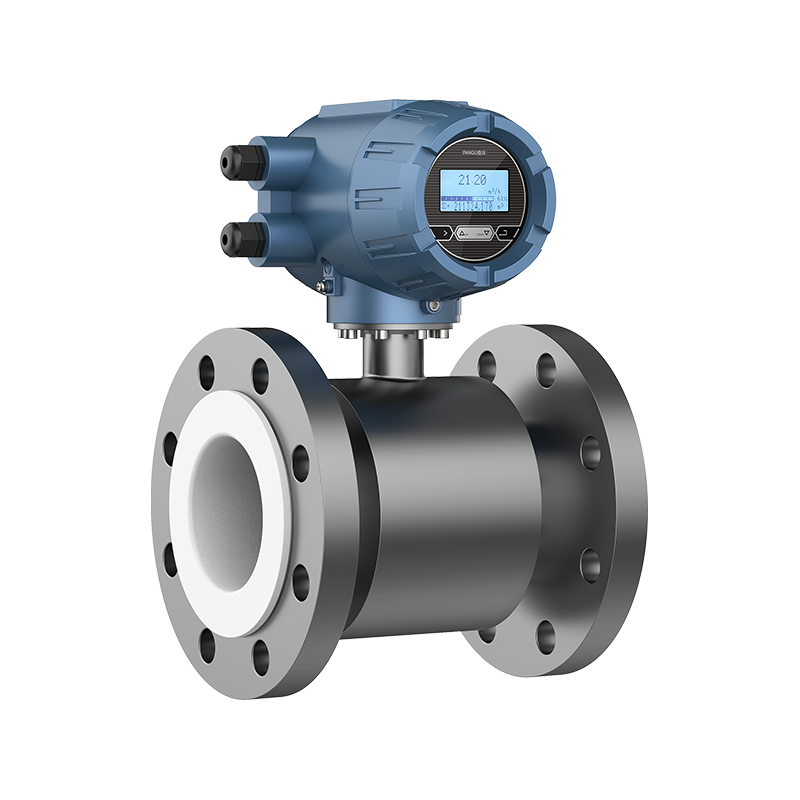
The meter consists of a flow tube lined with insulating material, two or more magnetic coils, two electrodes, and a converter. The pipe section is flanged or clamped into the pipeline. Because the wetted parts are non-moving, there is no rotor or turbine to stall.
How Does a Magnetic Water Flow Meter Work?
In essence: the meter generates a controlled magnetic field across the flow tube. As the water moves, it acts like a moving conductor. A voltage is induced at the electrodes, proportional to the average flow velocity. The converter multiplies the velocity by the pipe's cross-sectional area to calculate volumetric flow rate.
That measurement is independent of fluid temperature, pressure, density, and viscosity. It does not care whether the liquid is cold or hot, thin or thick, as long as it is conductive.
What Conductivity Is Required?
Most magnetic water flow meters require a minimum conductivity of 5 µS/cm. Tap water typically exceeds this threshold easily. Many industrial liquids and wastewater also meet it. If conductivity falls below that limit, the signal weakens and a special low-conductivity version may be needed.
Can It Measure Flow in Both Directions?
Yes. The induced voltage polarity reverses with flow direction. The transmitter determines direction and can report forward and reverse flows separately.
Key Advantages of Magnetic Water Flow Meters
- No moving parts: Nothing in the bore can wear out, catch debris, or jam. This makes the sensor almost maintenance-free.
- No pressure loss: The free, unobstructed bore keeps pump energy costs down.
- Broad accuracy: Modern transmitters achieve ±0.2% or ±0.5% of reading, which is sufficient for both process control and billing-grade water measurement.
- Unaffected by suspended solids: Magnetic meters measure the velocity of the fluid itself and can handle dirty water, sewage, and slurries.
- Corrosion resistance options: Electrode materials and liners can be selected to match the chemical exposure.
- Low maintenance: No seals, bearings, or moving parts to replace. Periodic verification is usually enough.
Bottom line: For conductive water applications, magnetic water flow meters offer the best balance of long-term accuracy, low maintenance, and installed cost.
At a glance: 0.2% to 0.5% of reading, no moving parts, zero pressure drop, DN15 to DN1000 coverage.
Choosing the Right Magnetic Water Flow Meter
Selection starts with the fluid and the environment. The good news is that a single meter body can be configured for many water applications by choosing the correct liner, electrodes, and connection style.
Liner and Electrode Materials
The liner isolates the pipe wall from the water. Common materials include PTFE, rubber, and polyurethane. PTFE suits most clean-water and chemical applications. Rubber is common for water and wastewater. Polyurethane is a rugged choice for slurry service. Electrodes are usually 316L stainless steel for tap water; Alloy C, titanium, or tantalum are used when the water is aggressive.
| Application | Liner | Electrode |
|---|---|---|
| Tap water supply | PTFE or rubber | 316L SS |
| Wastewater / sewage | Rubber | 316L SS |
| Chemical process water | PTFE | Hastelloy C or tantalum |
| Slurry / sludge | Polyurethane | 316L SS |
Meter Styles
The mounting style matters more than many engineers expect. There are four common configurations.
- Integrated type: The transmitter sits directly on the sensor. This is the lowest-cost, simplest installation for indoor or moderate ambient conditions.
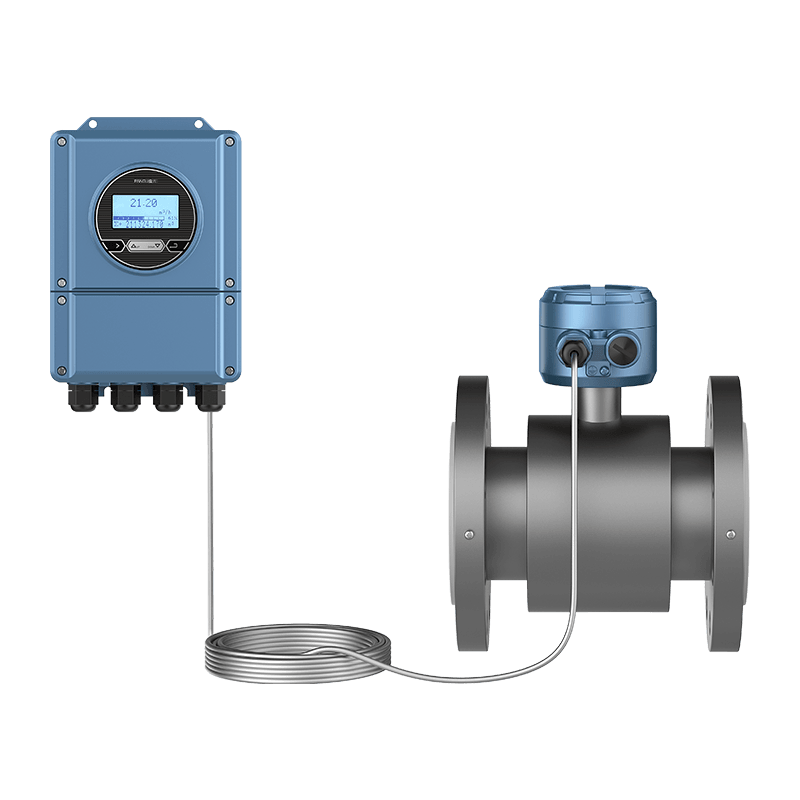
- Split type: The transmitter is mounted separately and connected by a signal cable. Use this when the pipe is underground, in a tight space, or where the display needs to be readable at a convenient height.
- Clamp-on type: The device attaches to the outside of an existing pipe. Here we are talking about a magnetic meter with clamp-type mounting, ideal for retrofits on existing steel or cast-iron pipelines.
- Insertion type: This is used on large pipes where a full-bore meter is too expensive. The insertion sensor measures velocity at a point and the transmitter extrapolates the full pipe flow.
If you need high accuracy for fiscal or batching duties, you can choose a high-precision magnetic water flow meter designed for ±0.2% measurement.
high-precision electromagnetic flowmeter for water flow measurement
 High-Precision Electromagnetic Flowmeter for Accurate Fluid MeasurementThis meter achieves 0.2% accuracy, ideal for dosing and irrigation systems. It features digital outputs and wireless integration, providing precise monitoring in demanding industrial applications.View Product →
For most installation situations, an integrated electromagnetic flow meter saves space and provides a familiar local display.
integrated electromagnetic flow meter for water metering
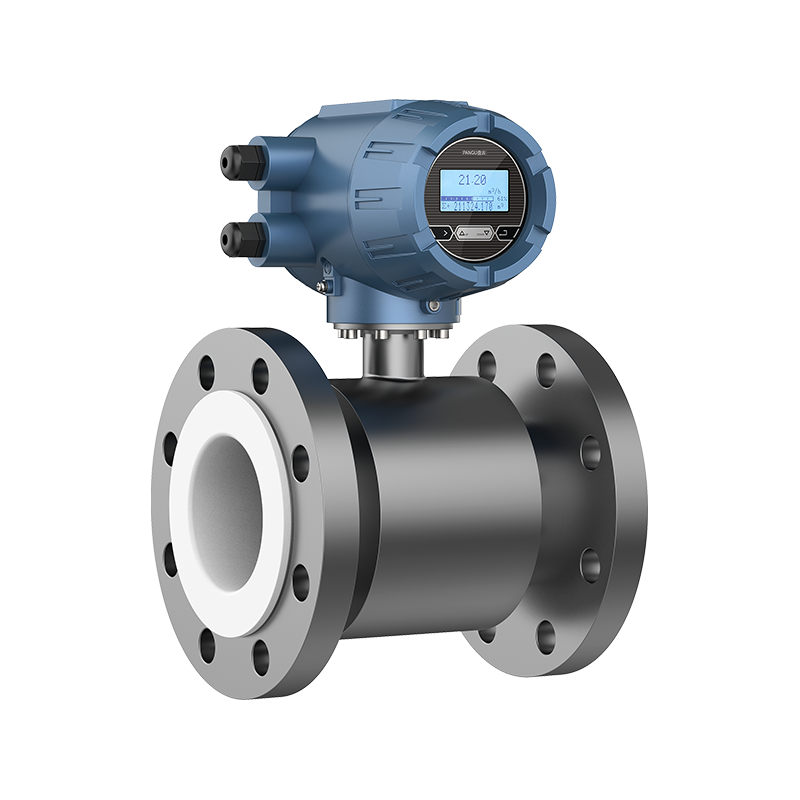 Integrated Electromagnetic Flow Meter with Local DisplayDesigned for conductive liquids, this integrated meter offers 0.5% accuracy and multiple outputs. Its compact design suits typical industrial settings, saving space while delivering reliable flow measurement.View Product →
When the pipeline is already in service, a clamp-type electromagnetic flow meter can be fitted without cutting the pipe.
clamp-type electromagnetic flow meter for retrofit installations
 Clamp-Type Electromagnetic Flowmeter for Retrofit InstallationsWith a flangeless design, this meter simplifies installation without cutting pipes. It maintains accuracy and supports standard outputs, fitting existing pipelines and cleaning easily.View Product →
Which Size to Choose?
The next question is pipe diameter. As a rule of thumb, choose a meter size that matches the pipe and keeps the velocity in the range of 0.5 m/s to 4 m/s. At these speeds, the meter remains in its best accuracy window and the pressure drop is negligible. If the flow velocity will always be much lower, a reducer can increase the velocity but must be considered carefully because a mismatched reducer can create a permanent pressure loss.
What Accuracy Can You Expect?
Standard magnetic water flow meters offer ±0.5% of reading. Higher-end meters achieve ±0.2%. The difference matters when the meter is used for billing, energy allocation, or batch mixing. For general process control, ±0.5% is already excellent.
What about IP Rating?
An IP67 or IP68 rating is a real-world benefit. A meter in a pit, a manhole, or a flooded pump station needs to survive water submersion. A split-type remote meter can protect the electronics above ground while the sensor remains in the flooded area.
Magnetic Water Flow Meters vs Other Flow Meters
To choose confidently, it is useful to compare magnetic meters with the alternatives commonly seen in water service.
| Criterion | Magnetic | Ultrasonic | Vortex | Turbine |
|---|---|---|---|---|
| Moving parts | None | None | None | Yes |
| Pressure loss | Minimal | Minimal | Moderate | Moderate |
| Works with dirty water | Yes | Generally yes | No | No |
| Needs conductivity | Yes | No | No | No |
| Typical accuracy | ±0.2-0.5% | ±0.5-1.0% | ±1.0% | ±0.5-1.0% |
| Bidirectional | Yes | Yes | No | Optional |
Magnetic meters come out ahead for most water applications because they do not restrict flow, are immune to suspended solids, and maintain accuracy over a long lifetime.
Common Applications for Magnetic Water Flow Meters
The same core technology fits a wide range of water duties. Here are the most common installations:
- Municipal water supply: Metering raw water, clearwell transfer, and distribution mains. Pangu's electromagnetic flow meters cover typical plant conditions, from small service lines to large mains.
- Wastewater and sewage: Magnetic meters handle thick, dirty liquid with suspended solids that would stop a turbine meter.
- Secondary water supply pump stations: Meters monitor outflow and help balance pressure in residential complexes and commercial buildings.
- Chemical and industrial process water: PTFE-lined meters withstand acids, alkalis, and other aggressive fluids in chemical plants.
- HVAC and chilled-water systems: The same magnetic meter is often paired with temperature sensors to calculate thermal energy.
- Printing and dyeing: Industrial water measurement and discharge metering in wet processes.
- Slurry and sludge lines: Polyurethane lined meters are used for lime slurry, sludge transfer, and other abrasive fluids.
If you are evaluating a municipal or industrial water project, review the water supply flow meter application guide to see how the instruments are applied in real water network installations.
Quality, Calibration, and Factory Support
The long-term performance of a magnetic water flow meter depends on the manufacturing quality and the calibration process. It is not enough to buy a meter off the shelf; the device has to be verified at actual water flow conditions before it leaves the factory.
Pangu Automation System Co., Ltd. has built a 4,000 square meter smart factory in Qiyun U High-Tech Industrial Park. The factory includes an SMT line for electronic board production and a fully automatic high-precision water flow calibration system covering DN15 to DN1000. The calibration rig uses three independent water flow loops and both the standard meter method and the static weighing method. Every meter is tested before shipping.
With more than two decades of industrial instrumentation experience, Pangu has accumulated the manufacturing discipline needed to deliver flow meters that stay accurate in the field. The company also holds a national metrology license, ISO9001, ISO10012, ISO14001, ISO45001, and CE EMC certification for its electromagnetic series. For installations in potentially explosive atmospheres, an explosion-proof certified series is available.
This is the kind of detail that matters when you install a meter for billing, process control, or environmental compliance. A meter without a traceable calibration is an estimate, not an instrument.
You can learn more about Pangu Automation and its production capabilities to evaluate the supplier beyond the meter itself.
FAQ
Q1: What is a magnetic water flow meter used for?
It is used to measure the volumetric flow rate of electrically conductive liquids such as tap water, process water, wastewater, and slurries in industrial and municipal systems.
Q2: Can magnetic water flow meters measure non-conductive liquids?
No. The technology requires an electrical conductivity of at least about 5 µS/cm. Petroleum, oils, and solvents are not measurable with a standard magnetic flow meter.
Q3: What is the typical accuracy of a magnetic water flow meter?
Standard models offer ±0.5% of reading. High-precision versions can achieve ±0.2% for billing or batching applications.
Q4: Do magnetic water flow meters need regular maintenance?
Negligible. Because there are no moving parts in the bore, the main maintenance task is periodic zero-point verification and inspection of the electrodes if the water deposits scale.
Q5: What is the difference between an integrated and a split-type magnetic flow meter?
In an integrated design, the transmitter is mounted directly on the sensor. In a split-type design, the transmitter is remote. The split type is preferred in tight spaces, underground pits, or high-temperature pipe environments.
The right magnetic water flow meter begins with the fluid you measure and the environment where it will live. Pay attention to the liner material, the electrode material, the mounting style, and the calibration behind the reading. With a decently engineered instrument, a conductive water line can be measured accurately for a decade or more without meaningful maintenance. That is the real value of the magnetic water flow meter: it stays out of your way and keeps delivering trustworthy numbers.
PREV:Electromagnetic Flow Meter Selection Guide: 5 Core Factors & On-Site Best Practices
NEXT:Electromagnetic Flow Meters: Pros, Cons, Selection Guide, and FAQs
NEXT:Electromagnetic Flow Meters: Pros, Cons, Selection Guide, and FAQs
Interested in cooperation or have questions?
Contact Us Now!
Kelly

+86 13967196545

pangusales@vip.163.com
Production Base:

Building 1 and Building 42, No. 889 Huancheng North Road, Deqing County, Huzhou City, Zhejiang Province
Jiji
+86 15397010616
pgsalesjiji@vip.163.com

+86-0571-87770830
Corporate Headquarters:
602-702, Block D, Building 3, Area B,Xigang New Territories, 206 Zhenhua Road,Hangzhou City, Zhejiang Province, China

Copyright © Hangzhou Pangu Automation System Co., Ltd. Rights Reserved.
Custom Digital Panel Mount Industrial Instruments Suppliers
