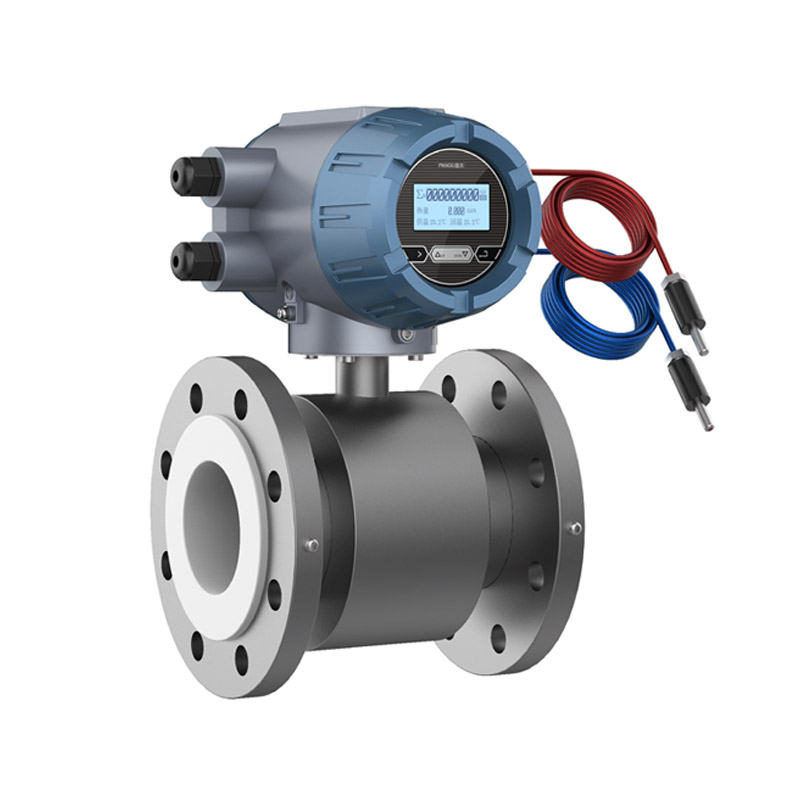
 Read More

 Get A Quote

How to Ensure Stable Performance of Electromagnetic Flowmeters: Installation & Best Practices
Home / News / Industry News / How to Ensure Stable Performance of Electromagnetic Flowmeters: Installation & Best Practices
Product Category
NEW Category
Contact us
Contact Us
We specialise in the research, development and manufacture of electrical wires and cables.
 +86 13967196545
Related News
- Electromagnetic Flow Meter Selection Guide: 5 Core Factors & On-Site Best Practices
- How to Choose a Liquid Flow Transmitter: Electromagnetic Types, Accuracy, Installation
- Electromagnetic vs Mechanical Flow Meters: How to Choose the Right One
- Digital Electromagnetic Flow Meter Suppliers: How to Source Directly from a Proven Manufacturer
How to Ensure Stable Performance of Electromagnetic Flowmeters: Installation & Best Practices
Content
- 1 1. Straight Pipe Length Requirements: Mitigating Fluid Turbulence
- 2 2. Strategic Mounting Positions: Preventing Common Site Hazards
- 3 3. Bypass Piping Design for Continuous Operation & Maintenance
- 4 4. Choosing the Right Electromagnetic Flow Meter Solution
- 5 Frequently Asked Questions (FAQ)
- 5.1 Q1: Why is my electromagnetic flow meter showing fluctuating readings or zero flow when liquid is moving?
- 5.2 Q2: What are the minimum straight pipe length requirements upstream and downstream for an electromagnetic flowmeter?
- 5.3 Q3: Can I install an electromagnetic flowmeter on the suction side of a pump?
- 5.4 Q4: How do I maintain continuous process flow during flowmeter cleaning or calibration?
- 6 Get Professional Flow Measurement Solutions
In industrial flow measurement, a well-known rule of thumb states: "Precision relies 30% on the product and 70% on correct installation." Even if you source high-precision equipment from a leading Smart Electromagnetic Flow Meters Company or specialized Digital Electromagnetic Flow Meter Suppliers, improper on-site installation can lead to measurement errors, fluid turbulence, and liner damage.
To help plant engineers and technical teams achieve consistent, high-accuracy measurements, this guide breaks down standard installation practices based on industry manuals and expert field guidelines.
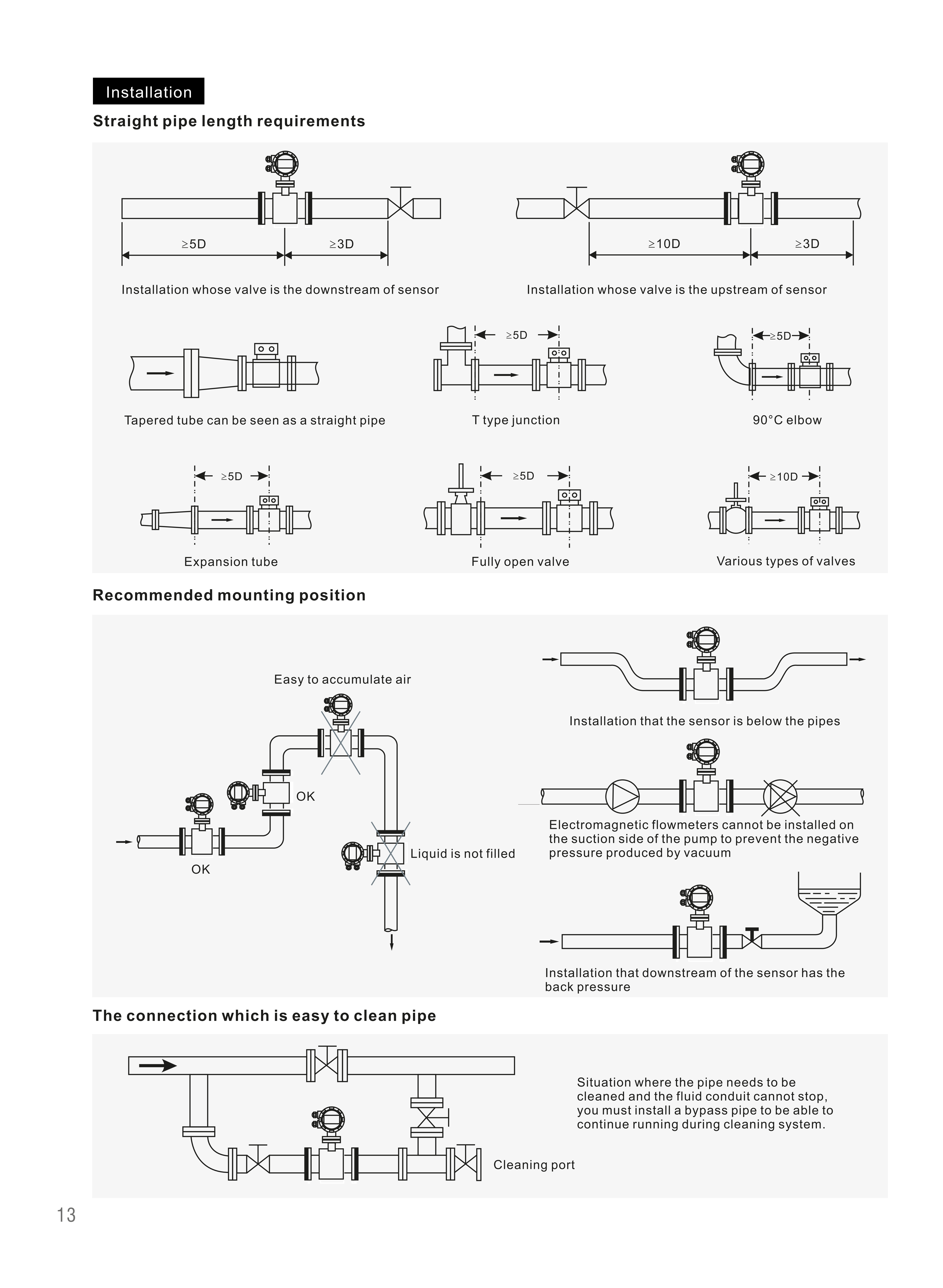
1. Straight Pipe Length Requirements: Mitigating Fluid Turbulence
To achieve accurate measurement, fluid entering the sensor's measuring tube must have a stable, symmetrical velocity profile. Valves, elbows, and pipe reducers disrupt this profile by creating turbulence and swirl. Maintaining proper upstream and downstream straight pipe lengths (measured in pipe diameters, D) is essential.
| Upstream Fitting / Configuration | Upstream Straight Pipe (Min.) | Downstream Straight Pipe (Min.) |
|---|---|---|
| Valve Downstream of Sensor | ≥ 5D | ≥ 3D |
| Valve Upstream of Sensor (Control/Isolation) | ≥ 10D | ≥ 3D |
| Reducers, T-Junctions, and 90° Elbows | ≥ 5D | ≥ 3D |
| Complex/Throttling Control Valve Setups | ≥ 10D | ≥ 3D |
2. Strategic Mounting Positions: Preventing Common Site Hazards
Prevent Gas Accumulation
Never install the electromagnetic flow meter sensor at the highest point of a piping system. Entrained air or gas bubbles naturally rise and collect at high points, causing severe signal fluctuations, zero-point instability, and measurement errors.
Guarantee Full Pipe Conditions
An electromagnetic flowmeter requires a completely full pipe to measure velocity accurately. Avoid installing sensors in partially filled lines. If installing in vertical piping, ensure the flow moves upward. Avoid vertical downward pipes unless sufficient downstream backpressure is guaranteed.
Avoid Pump Suction Lines
Never place the electromagnetic flow meter on the suction side of a pump. The negative pressure (vacuum) generated during pump operation can tear or collapse the sensor's protective liner. Always install the sensor on the pump discharge side.
Maintain Adequate Backpressure
Ensure adequate downstream backpressure so the measuring tube remains completely filled with liquid during all operating phases, including startup and shutdown sequences.
3. Bypass Piping Design for Continuous Operation & Maintenance
In process industries—such as chemical plants, municipal wastewater, or manufacturing facilities—shutting down the entire process for routine flow meter maintenance can be extremely costly.
- Bypass Assembly: A standard bypass loop equipped with isolation valves allows fluid to be re-routed around the flowmeter during maintenance.
- Cleaning Ports: Integrating cleaning ports with isolation valves allows technicians to clean the sensors or flush the line without disrupting continuous production lines.
4. Choosing the Right Electromagnetic Flow Meter Solution
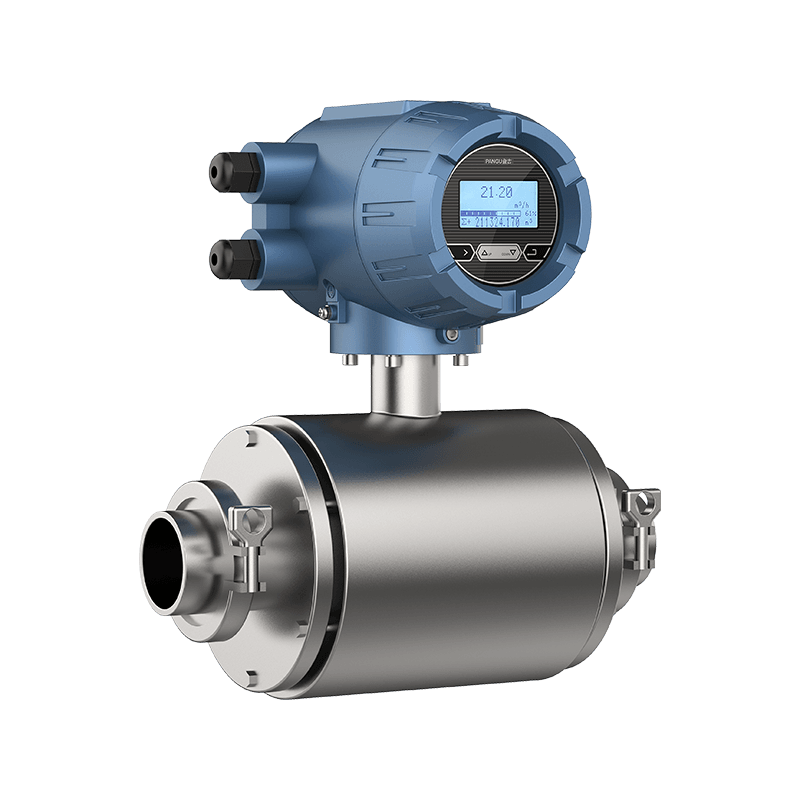
- Standard & Compact Installations: For space-constrained pipelines or quick maintenance requirements, partnering with Custom Digital Electromagnetic Flow Meter Manufacturers allows you to select customized Clamp Type Electromagnetic Flow Meters for compact integration.
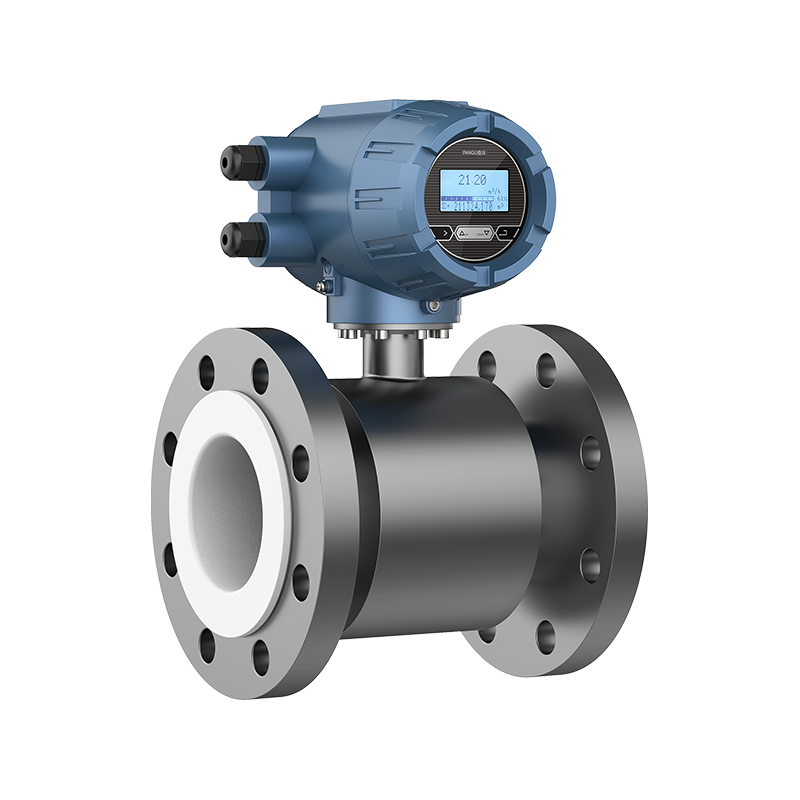
- Harsh & Corrosive Environments: When measuring aggressive media, consult a trusted China Chemical Liquid Magnetic Flowmeters Company to select chemically compatible liner materials (like PTFE or PFA) and corrosion-resistant electrodes.
- Low-Conductivity & Complex Fluids: For low-conductivity fluids or challenging industrial wastewater, sourcing from a specialized Wholesale Low Conductivity Electromagnetic Flowmeter Factory or Wholesale Low Conductivity Electromagnetic Flowmeter Company ensures reliable signal sensing under low-conductive threshold conditions.
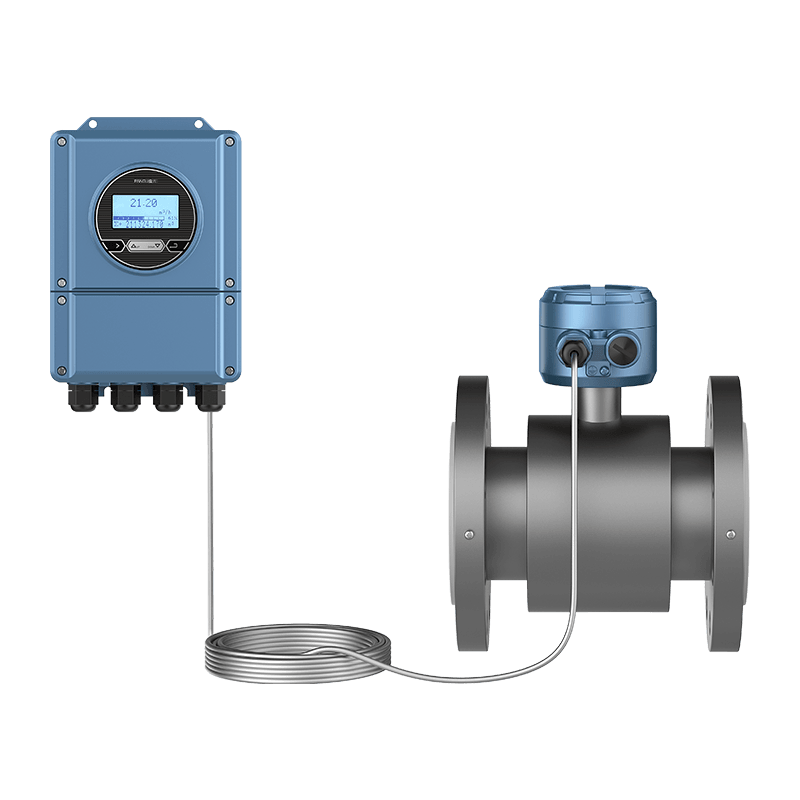
- High-Temperature, Vibration, or Remote Monitoring: In high-vibration pipelines or hazardous environments, working with a China Split Type Remote Electromagnetic Flow Meters Factory allows the primary converter to be mounted away from the sensing point. Pair these with advanced controllers from China Intelligent Digital Flow Totalizers Manufacturers or a certified China High Accuracy Digital Electromagnetic Flow Meter supplier to achieve real-time telemetry, data logging, and totalized flow monitoring across your facility.
Frequently Asked Questions (FAQ)
Q1: Why is my electromagnetic flow meter showing fluctuating readings or zero flow when liquid is moving?
A: Flow fluctuations or zero-flow readings are typically caused by gas accumulation at high pipeline points, incomplete pipe filling, or improper grounding. Ensure the sensor is not installed at the highest point of the system where air bubbles collect. Verify that the measuring tube is completely full of liquid during operation, and check that proper grounding rings or cables are installed to eliminate electrical noise interference.
Q2: What are the minimum straight pipe length requirements upstream and downstream for an electromagnetic flowmeter?
A: To eliminate turbulence and achieve a stable velocity profile, maintain at least ≥ 5D upstream and ≥ 3D downstream for standard valves/elbows, and extend upstream length to ≥ 10D if a control valve is positioned upstream of the sensor.
Q3: Can I install an electromagnetic flowmeter on the suction side of a pump?
A: No. Never install an electromagnetic flow meter on the suction side of a pump. The negative pressure (vacuum) generated during pump suction can severely distort, tear, or collapse the sensor's internal lining, leading to permanent equipment failure. Always mount the flow meter on the pump discharge side with adequate backpressure.
Q4: How do I maintain continuous process flow during flowmeter cleaning or calibration?
A: For continuous industrial processes where shutdown is impractical, install a bypass piping configuration. Incorporating a bypass line equipped with isolation valves and cleaning ports allows technicians to flush, clean, or service the flow meter without interrupting overall plant operations.
Get Professional Flow Measurement Solutions
Have questions about selecting the right electromagnetic flowmeter configuration for your application? Our technical team is ready to help you optimize pipeline design and flow accuracy.
PREV:Where Are Paperless Recorders Used? Key Industry Applications & Modular Hardware Selection Guide
NEXT:Color TFT vs. Blue LCD vs. Monochrome: Which Paperless Recorder Fits Your Budget and Visibility Needs?
NEXT:Color TFT vs. Blue LCD vs. Monochrome: Which Paperless Recorder Fits Your Budget and Visibility Needs?
Interested in cooperation or have questions?
Contact Us Now!
Kelly

+86 13967196545

pangusales@vip.163.com
Production Base:

Building 1 and Building 42, No. 889 Huancheng North Road, Deqing County, Huzhou City, Zhejiang Province
Jiji
+86 15397010616
pgsalesjiji@vip.163.com

+86-0571-87770830
Corporate Headquarters:
602-702, Block D, Building 3, Area B,Xigang New Territories, 206 Zhenhua Road,Hangzhou City, Zhejiang Province, China

Copyright © Hangzhou Pangu Automation System Co., Ltd. Rights Reserved.
Custom Digital Panel Mount Industrial Instruments Suppliers
