 Read More

 Get A Quote

Hangzhou Pangu Paperless Recorder Industrial Furnace Application and Installation Guide
Home / News / Industry News / Hangzhou Pangu Paperless Recorder Industrial Furnace Application and Installation Guide
Product Category
NEW Category
Contact us
Contact Us
We specialise in the research, development and manufacture of electrical wires and cables.
 +86 13967196545
Related News
- Applications of Paperless Recorders in Industrial Automation
- Where Are Paperless Recorders Used? Key Industry Applications & Modular Hardware Selection Guide
- Overcoming Flow Measurement Bottlenecks in Water Treatment: A Selection & Application Guide for Hangzhou Pangu’s Three Core Electromagnetic Flowmeters
- Synergizing Pangu Electromagnetic Flowmeters with Paperless Recorders: Precision Flow Control and Tamper-Proof Data Integrity
Hangzhou Pangu Paperless Recorder Industrial Furnace Application and Installation Guide
Content
INDUSTRIAL THERMAL PROCESS
INDUSTRIAL THERMAL PROCESS INSTRUMENTATION GUIDE
Standard Applications and Setup Guide for Hangzhou Pangu Paperless Recorders in Industrial Furnaces
In the daily operation of heat treatment furnaces, annealing furnaces, sintering kilns, vacuum furnaces, and industrial drying ovens, chamber temperature stability and process curve traceability directly determine product yield. Traditional mechanical chart recorders suffer from high consumable costs, frequent paper jams, and tedious manual data retrieval.
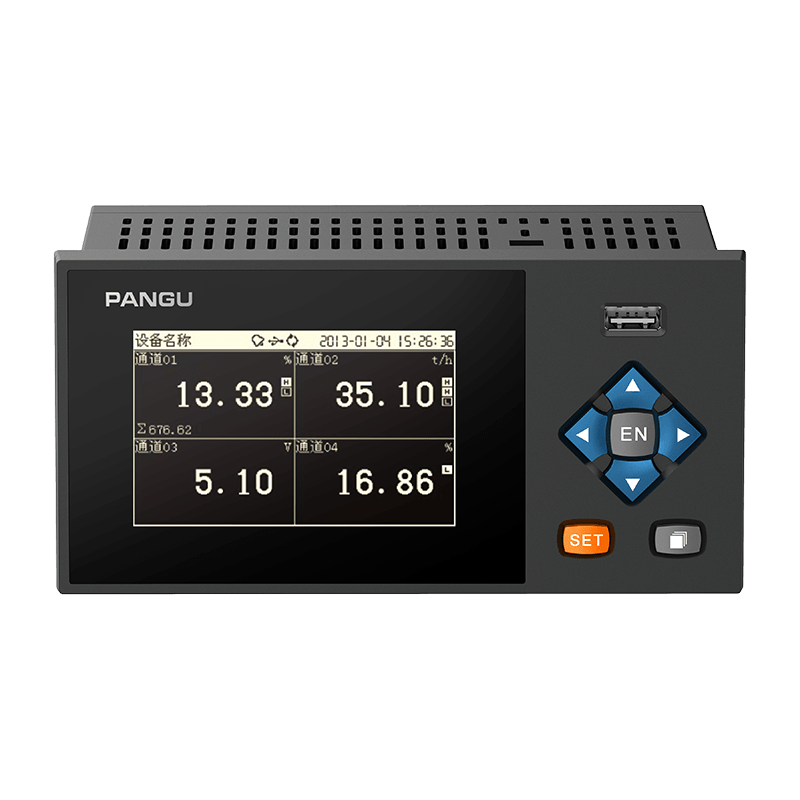
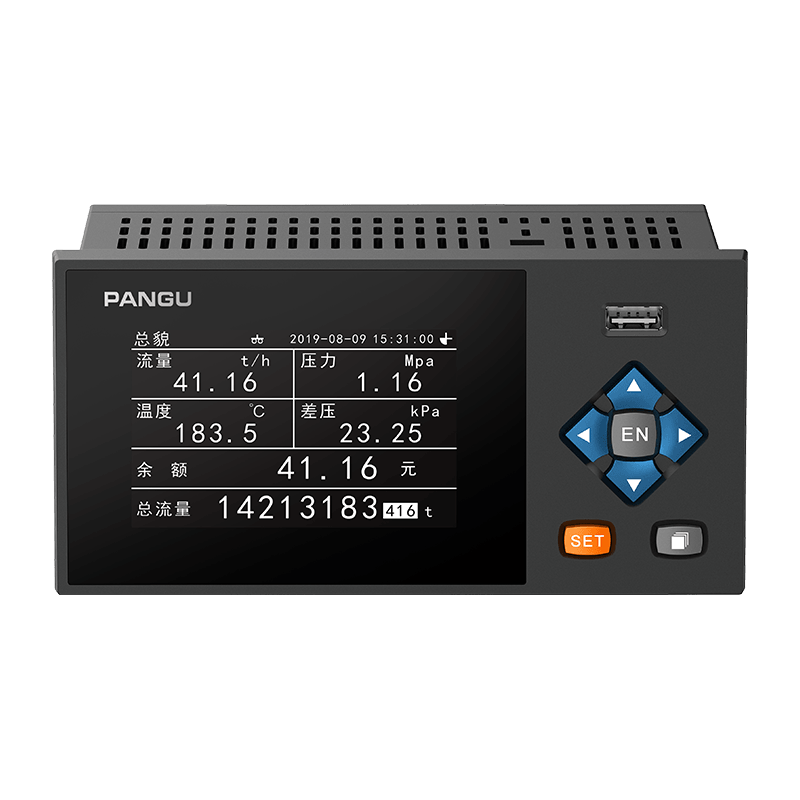
With high-precision signal acquisition, multi-channel synchronous display, and high-capacity internal storage, the Hangzhou Pangu paperless recorder has become a standard industrial data logger for both retrofitting legacy furnaces and building new automated thermal processing lines. Below is a practical guide to its core applications and installation best practices.

1. Four Core Applications of Pangu Data Loggers in Furnaces
Large continuous and batch furnaces-such as mesh belt furnaces, pusher kilns, and pit furnaces-are typically divided into preheating, heating, soaking, and cooling zones.
1.1 Multi-Zone Real-Time Monitoring & Curve Traceability
- Multi-Channel Synchronous Acquisition: Supporting 1 to 48 input channels, the Hangzhou Pangu multi-channel data logger captures signals across all thermal zones simultaneously. Operators can view real-time digital values, bar graphs, and historical trend curves on a single high-definition LCD screen to verify temperature uniformity inside the chamber.
- Universal Signal Input: Without requiring hardware module swaps, users can configure parameters directly via the menu to accept Type K, S, B, and R thermocouples, Pt100 RTDs, as well as 4-20mA transmitter signals for furnace pressure or gas flow-enabling unified thermal and process monitoring.
1.2 Over-Temperature Alarms & Safety Interlock Protection
During extended high-temperature runs, a malfunctioning temperature controller or welded contactor can cause severe overheating, scrapped batches, or equipment damage.
- Multi-Level Alarm Thresholds: Each channel supports independent High, High-High, and Low alarm limits.
- Relay Interlock Control: When chamber temperature exceeds safe limits, built-in alarm relays trigger external audio-visual alarms to alert operators and can be wired in series with the main contactor control loop to automatically cut off heating power, providing dual-layer hardware protection.
1.3 Compliant Process Data Storage & One-Click USB Export
In automotive, aerospace, and fastener manufacturing, quality audits (such as CQI-9 Heat Treat System Assessments) mandate complete, tamper-evident temperature logs for every batch.
- Non-Volatile High-Capacity Memory: Built-in Flash memory retains all historical records safely even during sudden power outages. Sampling intervals are adjustable (e.g., 1 to 60 seconds) based on cycle duration.
- Driver-Free USB Transfer: Once a heat cycle finishes, operators simply plug a standard USB flash drive into the front USB port to export encrypted or universal-format data. Using Hangzhou Pangu's complimentary PC analysis software, engineers can generate and print time-temperature batch reports immediately, eliminating manual logbooks.
1.4 Retransmission Output & Centralized SCADA/MES Networking
For facilities operating multiple furnaces simultaneously, standalone machine-side monitoring limits operational efficiency.
- Isolated RS485 Communication: Equipped with an isolated RS485 port running the standard Modbus-RTU protocol, the data logger integrates seamlessly into plant-wide networks.
- Central Control Room Integration: Dozens of recorders across annealing or quenching lines can be linked to central SCADA software (such as WinCC, KingView, or MCGS) or enterprise MES systems for remote real-time supervision and automated archiving.
2. Sensor & Function Selection by Furnace Type
Depending on operating temperatures and process requirements, pairing the Hangzhou Pangu temperature data logger with the right thermocouple and configuration optimizes accuracy and service life:
| Industrial Furnace Type | Typical Temp Range | Recommended Sensor | Primary Pangu Data Logger Focus |
|---|---|---|---|
| Drying Ovens / Aging Furnaces | 50 °C - 300 °C | Pt100 RTD / Type K Thermocouple | Multi-point uniformity checks, timed logging, batch USB export |
| Mesh Belt / Tempering / Carburizing Furnaces | 300 °C - 950 °C | Type K / Type N Thermocouple | Multi-zone curve display, CQI-9 compliant data traceability |
| High-Temp Sintering / Ceramic Kilns / Forging | 1000 °C - 1600 °C | Type S/R/B Noble Metal Thermocouples | High-precision cold-junction compensation, over-temp cutoff interlock, RS485 networking |
| Vacuum Heat Treatment Furnaces | 600 °C - 1300 °C | Type K/S Thermocouple + Vacuum Gauge | Mixed logging of chamber temperature and vacuum pressure (4-20mA) |
3. Field Installation & Wiring Best Practices
Industrial furnace workshops feature intense heat and strong electromagnetic interference (EMI). Follow these three guidelines during installation to ensure measurement stability:
- Use Matching Compensating Cables: Thermocouple outputs are low-level millivolt signals. Never run standard copper wire between the furnace terminal head and the recorder; always use dedicated compensating cables matching the thermocouple type (e.g., KX cable for Type K) and observe strict polarity to prevent measurement drift.
- Separate Power and Signal Wiring: Furnace control cabinets house high-power SCRs (thyristors) and contactors that generate heavy EMI. Route sensor signals using shielded twisted-pair cables inside dedicated metal conduits, separated from 380V/480V power lines, and ground the shield at a single point on the data logger side.
- Protect Against Ambient Heat and Moisture: The standard operating ambient temperature for Hangzhou Pangu paperless recorders is 0 °C - 50 °C. Avoid mounting control panels directly above furnace doors or exhaust vents, as radiant heat degrades LCD longevity and compromises internal cold-junction compensation accuracy.
4. Frequently Asked Questions (FAQ)
Q1: Can a Hangzhou Pangu data logger directly control furnace heating instead of a separate temperature controller?
Yes, for basic applications. If your furnace requires simple ON/OFF control, the recorder's built-in alarm relays can drive heating contactors directly. For tight temperature uniformity or multi-step ramp/soak profiles, pair the data logger with a Pangu multi-loop PID temperature controller or select a Pangu recorder model equipped with integrated PID control outputs.
Q2: Will recorded furnace data be lost if the plant experiences a sudden power failure?
No. Hangzhou Pangu paperless data loggers store data in non-volatile Flash memory, preserving all historical records permanently without power. An internal lithium backup battery maintains the real-time clock, automatically logging power-loss timestamps and resuming recording as soon as power returns.
Ready to Optimize Your Industrial Furnace Monitoring?
Contact our technical engineering team today for customized paperless recorder configuration and multi-zone thermal logging solutions.
Contact Us Now
PREV:Digital Electromagnetic Flow Meter Suppliers: How to Source Directly from a Proven Manufacturer
NEXT:The Cost of Industrial Data Loss: How Paperless Recorders Secure Critical Production Processes
NEXT:The Cost of Industrial Data Loss: How Paperless Recorders Secure Critical Production Processes
Interested in cooperation or have questions?
Contact Us Now!
Kelly

+86 13967196545

pangusales@vip.163.com
Production Base:

Building 1 and Building 42, No. 889 Huancheng North Road, Deqing County, Huzhou City, Zhejiang Province
Jiji
+86 15397010616
pgsalesjiji@vip.163.com

+86-0571-87770830
Corporate Headquarters:
602-702, Block D, Building 3, Area B,Xigang New Territories, 206 Zhenhua Road,Hangzhou City, Zhejiang Province, China

Copyright © Hangzhou Pangu Automation System Co., Ltd. Rights Reserved.
Custom Digital Panel Mount Industrial Instruments Suppliers
